
| Share On: | |
|---|---|
| Categories: | PCI Data Acquisition Boards |
| Review: | Write your review |
| Resources: |  User's ManualQuick StartData Sheet User's ManualQuick StartData Sheet SoftwareRelease Note SoftwareRelease Note |
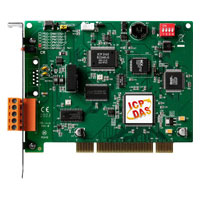
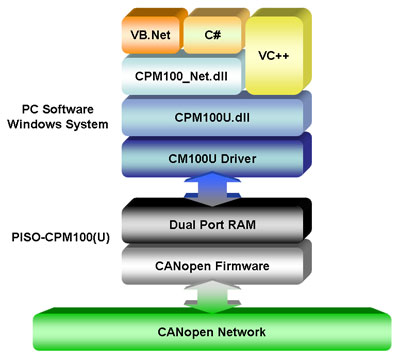
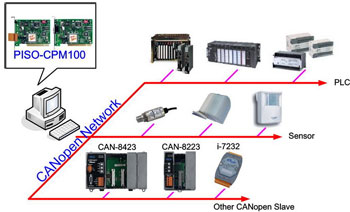 The PISO-CPM100 gives a very powerful and economic solution of an active CANopen master device with one CAN channel. It uses the NXP SJA1000T and 82C250 to be the CAN controller and transceiver, which provide bus arbitration, error detection with auto correction and re-transmission function. The 16-bit on-board microcontroller with real-time O.S., MiniOS7, allows many features, such as real-time message transmission and reception, filtering, preprocessing, and storage of CAN messages. Under the effect of the powerful microcontroller, this card can be made for one CAN controller manager without losing data, even in systems with a high PCI bus load. Therefore, the CANopen critical process can be implemented directly by CANopen firmware in the PISO-CPM100. In addition, users can develop their CANopen application by using the CANopen library on the host computer. When the PISO-CPM100 is active, the data exchange between users’ application and CANopen firmware is performed via the memory mapping method of the PISO-CPM100.
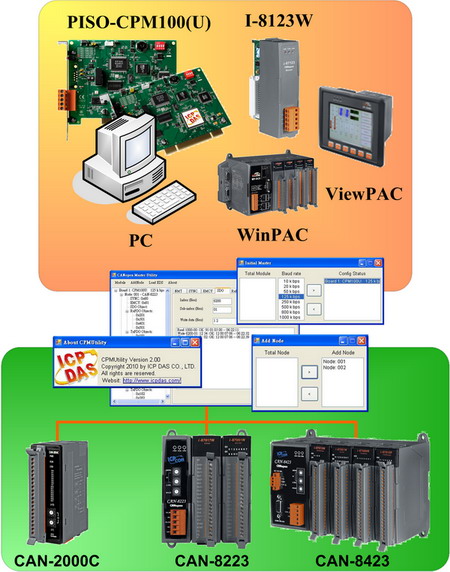
The software utility can easily to access the I/O data of all the slave devices. The users can monitor the input data of the specific slave device and change the output data to the remote slave device with this utility
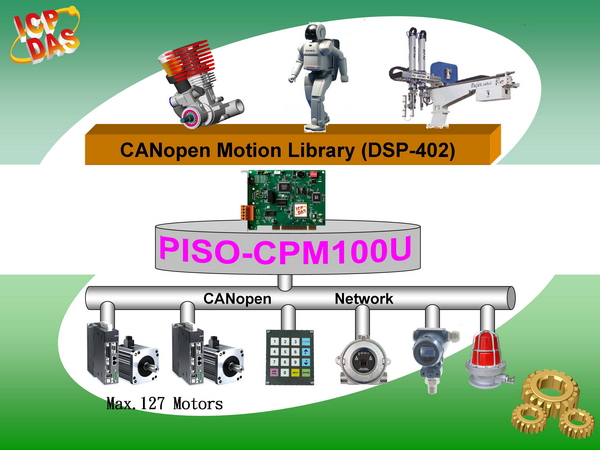
The PISO-CPM100U provides the motion control library now. This library follows the CANopen standard DSP-402. It is available on the Windows 2000/XP/Vista or Win 7(32-bit version) operation system. The DSP-402 is one kind of the standard CANopen application profiles, and specially designed for motion control systems. In addition to making the management of the CANopen motors easy, this communication protocol can reduce the wire connection between the controller and motors, and provide rapid troubleshooting functions. With the PISO-CPM100U and CANopen Motion Library, you can do various motion control functions, such as position control, velocity control, toque control, and synchronous action without having the background knowledge of the complex and abstruse CANopen protocol. The CANopen Motion Library is able to link many CANopen motors so that the multi-axis motion control by one host becomes reachable. While controlling motors, you can also use the APIs of the PISO-CPM100U library to access CANopen remote I/O modules which follows the DSP-401 at the same time. Therefore, building a motion control application becomes more easy and convenient.
Feature:
Hardware Compare
Performance Test with PISO-CAN 200/400-D/T
Product Name |
PISO-CPM100 |
PISO-CAN-200/400 with CANopen Library |
Protocol decoder |
186 CPU |
PC CPU |
Time stamp |
186 Timer (0.1 ms) |
PC Timer (about 1 ms) |
CPU Loading |
Light |
Heavy |
Performance |
High |
Normal |
Application |
Various and complex CANopen application |
General purpose CANopen application |
Test environment:
CPU:Intel(R) Pentium(R) 4 CPU 2.40 GHz
OS:Microsoft Windows XP Professional Version 2002 Service Pack 2
RAM:512 MB
CAN Baudrate:1000 bps
Test result:
Function |
PISO-CPM100 (ms) |
PISO-CAN200/400 with CANopen library (ms) |
Add Node |
Average 45.502 |
1265 ~ 1280
|
Read 4 bytes data by SDO |
Average 2.487 |
19.37 ~ 19.47
|
Read 9 bytes data by SDO |
Average 2.971 |
58.21 ~ 58.61
|
Write 4 bytes data by SDO |
Average 2.479 |
18.81 ~ 19.69
|
Read 8 bytes data by PDO |
Average 2.355 |
16.49 ~ 16.57
|
Write 8 bytes data by PDO |
Average 1.738 |
0.13 |
Note 1: |
The data of above list is average of 1000 message. |
Node 2: |
If user use the guarding function with PISO-CAN200/400 with CANopen library, the guard error event may be occured when the slave is more and the guarding time is shorter. This is because of that the accuracy of timer of windows is not enough. |
Model Name |
PISO-CPM100U-D |
PISO-CPM100U-T |
Hardware
|
||
CPU |
80186, 80 MHz or compatible
|
|
SRAM/Flash/EEPROM |
512 KB / 512 KB / 2 KB
|
|
Bus Interface
|
||
Type |
Universal PCI supports both 5 V and 3.3 V PCI bus
|
|
Board No. |
By DIP switch
|
|
CAN Interface
|
||
Controller |
NXP SJA1000T with 16 MHz clock
Microprocessor inside with 80186 80 MHz |
|
Transceiver |
NXP 82C250
|
|
Channel number |
1
|
|
Connector |
9-pin male D-Sub (CAN_L, CAN_SHLD, CAN_H, N/A for others) |
5-pin screwed terminal block (CAN_L, CAN_SHLD, CAN_H, N/A for others) |
Baud Rate (bps) |
10 k, 20 k, 50 k, 125 k, 250 k, 500 k, 800 k, 1 M
|
|
Transmission Distance (m) |
Depend on baud rate (for example, max. 1000 m at 50 kbps )
|
|
Isolation |
3000 VDC for DC-to-DC, 2500 Vrms for photo-couple
|
|
Terminator Resistor |
Jumper for 120 Ω terminator resistor
|
|
Specification |
ISO-11898-2, CAN 2.0A and CAN 2.0B
|
|
Protocol |
CANopen DS-301 ver4.02
|
|
LED
|
||
Round LED |
Green LED, Red LED
|
|
Software
|
||
Driver |
Windows 2K/XP
|
|
Library |
VB 6.0, VC++ 6.0, BCB 6.0
|
|
Power
|
||
Power supply |
-
|
|
Power Consumption |
300 mA @ 5 V
|
|
Mechanism
|
||
Dimensions |
138 mm x 22mm x 127 mm (W x L x H)
|
|
Environment
|
||
Operating Temp. |
0 ~ 60 ℃
|
|
Storage Temp. |
-20 ~ 80 ℃
|
|
Humidity |
0 ~ 95% RH, non-condensing |
|
Our mission is to provide the absolute best customer experience in industrial automation and electronics, without exception.


Subscribe to our mailing list today and join thousands of others who want to stay up-to-date with the latest news in data acquisition and industrial data communication.
ICP DAS USA is a leading manufacturer of industrial data acquisition, data communication, programmable controllers, wireless and software solutions.
Add a review
Your email address will not be published. Required fields are marked *