
Smart Aquaculture: Water Conservation and Stable Temperature Monitoring
Introduction
According to Taiwan Fisheries Agency statistics, freshwater aquaculture production in Taiwan reached 259,175 tons in 2018, generating an output value of approximately NT$31.7 billion across 33,594 hectares of farming area.
In recent years, the aquaculture industry has faced growing challenges from extreme weather events such as heat waves, heavy rainfall, and cold fronts, increasing production risks and operational costs. To improve sustainability and resilience, fish farmers are adopting renewable energy sources such as solar and wind power to reduce reliance on traditional electricity and lower carbon emissions.
At the same time, IoT technologies are helping modernize aquaculture through smart farming, remote monitoring, and early warning systems. These digital solutions enable farmers to improve productivity, reduce costs, better manage environmental risks, and support long-term sustainable growth.
ICP DAS USA Smart Aquaculture Solution for Water Conservation and Temperature Control
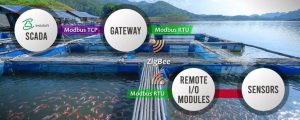
This application combines solar and wind power generation with real-time monitoring of water quality and temperature data collected from multiple sensors. Beyond data acquisition, the solution uses industrial automation to optimize energy usage, reduce water consumption, improve feeding management, and protect aquatic livestock during cold weather conditions.
Because fish ponds are often located far from the central control room, the system utilizes ZigBee wireless communication, I/O modules, and communication gateways to seamlessly integrate field devices and simplify deployment. This enables reliable remote monitoring and control while reducing wiring costs and supporting efficient, sustainable aquaculture operations with ICP DAS USA solutions.
Power Generation and Energy Monitoring
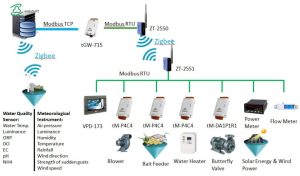
Power meters monitor energy generated by solar panels and wind turbines, as well as electricity consumed by equipment such as automatic feeders and water heaters. Using ZT-2551 ZigBee slave modules and ZT-2550 ZigBee host modules, power data is transmitted wirelessly to the central control room, where voltage, current, power, and energy usage data are stored for analysis and monitoring.
Water Quality and Weather Monitoring
Water quality sensors continuously collect critical aquaculture data, including water temperature, dissolved oxygen (DO), pH, electrical conductivity (EC), oxidation-reduction potential (ORP), ammonia (NH4), and light intensity. Weather stations monitor environmental conditions such as temperature, humidity, air pressure, rainfall, wind speed, and wind direction. All data is sent to the central control system via ZigBee wireless communication and stored in a database for real-time monitoring and historical analysis.
Automated Control and Smart Operations
To support intelligent farm management, tM-P4C4 and tM-DA1P1R1 remote I/O modules connect field devices to the monitoring system, enabling remote control from the central control room.
The system automatically responds to changing conditions. For example, when air or water temperatures fall below preset thresholds, water heaters are activated to maintain optimal conditions for fish growth. If water temperatures become too high, cooling measures such as opening water valves and starting air blowers are triggered automatically.
Operators can also automate feeding schedules or adjust feeding amounts, intervals, and frequency based on fish growth and operational requirements.
Alarm Management
The system allows operators to define upper and lower alarm limits for key parameters, including power consumption, water temperature, pH, and dissolved oxygen levels. When values exceed preset thresholds, alerts are generated immediately, helping operators respond quickly and prevent losses. Historical alarm records are also available for review and analysis.
Data Reporting and Analysis
Operators can easily search historical data by date and export records to Excel for reporting, performance analysis, and farm management purposes.
Real-Time Local and Remote Monitoring
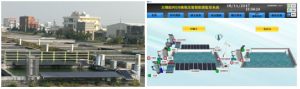
Using SCADA software, all devices are integrated into a centralized monitoring platform that provides real-time data, trend charts, and system status information through a web browser. This enables operators to monitor farm conditions from anywhere.
On-Site Monitoring and Control
At the fishpond, VPD-173 HMI panels provide operators with convenient access to real-time information from heaters, feeders, water valves, and other equipment. This allows staff to monitor system performance and make manual adjustments when needed.
Benefits of the ICP DAS USA Smart Aquaculture Solution
Conclusion
After deployment at the Fisheries Research Center, the smart aquaculture system demonstrated measurable improvements in both energy and water efficiency. By utilizing solar and wind power, the facility reduced annual electricity costs by approximately NT$20,000 per user. Automated water valve control also minimized unnecessary water usage, reducing groundwater extraction while maintaining suitable water quality.
During colder seasons, the system automatically controls water heaters to protect aquatic livestock from temperature-related stress. By continuously monitoring water conditions, it intelligently manages heating and water circulation to optimize both energy and water consumption.
With extensive experience in industrial automation and IoT, ICP DAS USA delivers reliable smart solutions across a wide range of applications. Its comprehensive product portfolio, spanning sensors, controllers, communication devices, and software, enables customers to build efficient, scalable, and easy-to-manage monitoring and control systems tailored to their operational needs.


