
ZigBee is a specification based on the IEEE 802.15.4 standard for wireless personal area networks (WPANs). ZigBee operates in the ISM radio bands and defines a general-purpose, inexpensive, self-organizing mesh network for industrial control, embedded sensing, medical data collection, smoke and intruder warning, building automation, home automation, and other similar applications.
There are three different types of ZigBee devices in a ZigBee network:
View our line of Zigbee products
There are three topologies defined in the IEEE 802.15.4 standard: Star, Cluster Tree, and Mesh.
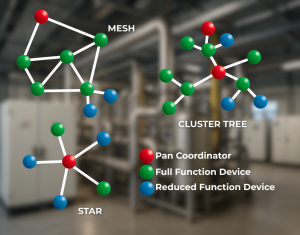
ZigBee uses a basic master-slave configuration that is well-suited for the static star networks of many infrequently used devices that communicate via small data packets. Up to 254 nodes are supported in a single ZigBee network.
While ZigBee focuses on control and automation, Bluetooth focuses on connectivity between laptops, PDAs, and similar devices, as well as general cable replacement.
ZigBee uses a lower data rate and lower power consumption, making it ideal for small-packet devices. In contrast, Bluetooth uses a higher data rate and higher power consumption and is designed for large-packet devices.
Compared to Bluetooth, ZigBee networks can support a larger number of devices and allow a longer communication range between them.
The SST-2450 is used for long-distance wireless applications (up to 20 km) and is suitable for simple half-duplex networks.
ZigBee, on the other hand, supports various network topologies such as star, cluster tree, and mesh. It also supports repeater functionality, making it more suitable for redundancy systems.
The ZT-2570/ZT-2571 is an Ethernet/RS-485/RS-232 to ZigBee network converter. It enables RS-232/RS-485 devices to be wirelessly and easily connected to a new or existing system.
The ZT-2570 acts as the network host, while the ZT-2571 functions as the network slave. These devices support various data formats and baud rates, which can be configured via a Windows-based GUI utility. The ZT-2570/ZT-2571 can implement an ad-hoc, star or mesh network topology.
In some existing systems that use an Ethernet/RS-485/RS-232 networks, it is sometimes difficult to extend the new devices due to building structure issues, wiring limitations, or other challenges. The ZT-2570/ZT-2571 can be easily added to an existing system in order to extend the network worelessly.
The ZT-2550/ZT-2551 is a RS-485/RS-232 to ZigBee Network converter. It enables RS-232/RS-485 devices to be wirelessly and easily connected to a new or existing system.
The ZT-2550 serves as the network host and ZT-2551 is the network slave. It also supports various data formats and baud rates that can be configured via a Windows-based GUI utility. The ZT-2550/ZT-2551 can implement an ad-hoc, star or mesh network topology.
In some existing systems that use a RS-485/RS-232 network, it is sometimes difficult to extend the new devices due to building structure issues, wiring limitations, or other challenges. The ZT-2550/ZT-2551 can be easily added to an existing system in order to extend your network.

For advanced wireless applications, repeaters and mesh networks are required in order to build a more flexible and reliable network.
The ZT-2510 can be used to avoid obstacles that may block communication between two wireless devices or to extend the wireless transmission range.


The mesh feature is the most important function for wireless transmission. Wireless communication is greatly affected by humidity, temperature, weather, and obstacles. Therefore, a mesh network topology is essential to overcome such interference, especially in an industrial environment. The benefits of using a mesh topology are shown below:


The ZT-2570 integrates seamlessly with the ZT-2000 Series for flexible, wireless data acquisition and control in ZigBee-based systems.


