
Integrated Vessel Safety & Monitoring
Introduction
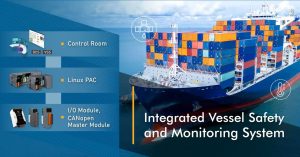
During navigation, vessels require comprehensive safety and damage control systems to protect both the vessel and its crew. The Damage Control System (DCS) monitors critical conditions such as compartment flooding, temperature anomalies, and pipeline pressure. When an emergency occurs, it can trigger appropriate responses, including drainage systems and fire pumps. The Vessel Safety System monitors onboard equipment, fire alarms, emergency doors, and other critical safety functions.
To enhance vessel safety, the customer sought to upgrade its existing onboard safety and damage control systems. However, the vessel’s complex architecture included multiple subsystems for fire detection, compartment flooding monitoring, generator management, and more. Integrating these systems and enabling centralized monitoring presented a significant challenge.
To address these requirements, ICP DAS USA provided compatible and reliable controllers, I/O modules, and communication gateways, helping the customer build a more integrated and dependable vessel safety and damage control solution.
Smart Integration for Comprehensive Real-Time Vessel Monitoring
The solution consists of two primary systems: the Damage Control System (DCS) and the Vessel Safety System.
1. Damage Control System (DCS)
To ensure continuous transmission of critical data, the customer required a dual-CAN bus architecture that could maintain communication even if one channel failed.
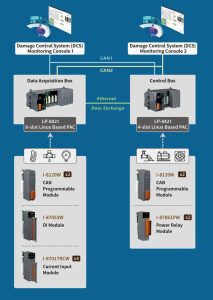
The system uses a proprietary communication protocol developed by the customer to collect signals related to compartment flooding, temperature, and pipeline pressure through data acquisition boxes. These signals are transmitted via the proprietary CAN protocol to the DCS host computer.
The host computer then communicates with the control box to execute critical actions, including activating drainage systems and fire pumps, opening or closing bottom valves, and remotely shutting down ventilation fans.
2. Dual-CAN Bus Architecture
The system uses a dual-CAN bus architecture to provide reliable communication and maintain data transmission even if one CAN channel fails. ICP DAS USA LP-8821 and LP-8421 Linux-based controllers are used in the data acquisition and control box subsystems, respectively. Each controller is equipped with an I-8120W 1-port CAN programmable module, enabling CAN bus communication with the Damage Control System (DCS) monitoring platform.
The I-8120W is a standalone, programmable CAN bus module designed for integration with ICP DAS USA PAC series controllers. It allows the controller to transmit and receive CAN messages without placing additional processing load on the CPU. Combined with the PAC’s RS-232, RS-485, and Ethernet interfaces, the I-8120W provides a flexible solution for CAN bus-based control and data acquisition applications.
3. Data Monitoring via the Data Acquisition Box
The data acquisition box uses the I-87053W 16-channel isolated digital input module and I-87017RCW 8-channel current input module to collect signals related to compartment flooding, temperature, and pipeline pressure. The LP-8821 Linux-based controller processes the collected data and transmits it to the DCS host computer using the customer’s proprietary CAN protocol for centralized monitoring.
The I-87053W provides 16 isolated digital input channels with electrical noise filtering, dual watchdog protection, and individual channel configuration. Its inputs can also function as 16-bit counters, providing additional flexibility for monitoring applications.
The I-87017RCW provides eight current input channels with built-in resistors for direct current measurement. It supports normal and high-speed sampling modes, with independently configurable input ranges of 0 to +20 mA, +4 to +20 mA, and -20 to +20 mA.
The LP-8821 is a Linux-based PAC powered by a Cortex-A8 processor and supports communication interfaces including VGA, USB, Ethernet, and RS-232/RS-485. With eight I/O expansion slots, it supports ICP DAS USA I-8KW and I-87KW series I/O modules for flexible data acquisition.
4. Data Monitoring and Local Control
The control box uses the I-87061PW 16-channel power relay output module to receive commands from the DCS host computer and control connected equipment. The LP-8421 Linux-based controller also retrieves data from the acquisition box via Modbus TCP, including flooding status, temperature readings, and pressure signals.
The LP-8421 provides local logic control for critical functions such as activating drainage systems, starting fire pumps, and controlling ventilation units. This local control capability allows essential operations to continue even if communication with the central host computer is interrupted.
The I-87061PW provides 16 independently controlled relay output channels and includes a dual watchdog timer, with configurable power-on values and safe value output settings.
Digital and Analog Signal Acquisition for Equipment Status and Fire Alarms
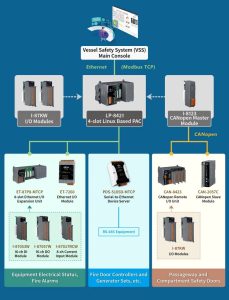
ICP DAS USA provided an ET-87P8-MTCP 8-slot Intelligent Ethernet I/O Expansion Unit with I-87KW series I/O modules, including the I-87053W 16-channel isolated digital input module, I-87057W 16-channel isolated digital output module, and I-87017RCW 8-channel current input module. An ET-7260 Ethernet I/O module was also installed to collect equipment status signals, including contact points, indicator lights, alarms, door and window limit switches, emergency switches, and fire alarm signals.
Because these signals are distributed throughout the vessel, from the deck to lower compartments, seven ET-87P8-MTCP units were deployed across the vessel. The ET-87P8-MTCP and ET-7260 transmit collected data to the LP-8421 controller via Modbus TCP.
The ET-87P8-MTCP provides eight I/O expansion slots and supports I-87KW series I/O modules over Ethernet. Its dual Ethernet ports support daisy-chain configurations, simplifying network wiring across multiple units. It also supports Modbus TCP, Modbus RTU/ASCII, and Modbus TCP-to-RTU/ASCII gateway functionality, enabling flexible integration with different Modbus networks.
The I-87057W 16-channel isolated digital output module provides protection against overvoltage, overload, and short-circuit conditions. It supports configurable Power-On and Safe Values, optocoupler isolation, and individual LED indicators for monitoring output status.
The ET-7260 Ethernet I/O module combines a two-port Ethernet switch with six digital inputs and six power relay outputs, providing a compact solution for monitoring and controlling vessel equipment.
Safety Door and Compartment Monitoring
For critical passageway and compartment safety doors, the customer required CANopen communication. To meet this requirement, ICP DAS USA deployed an I-8123W CANopen master module, CAN-2057C CANopen slave modules, and CAN-8423 remote I/O units equipped with I-87KW series I/O modules.
The I-8123W provides a dedicated CAN bus interface for communicating with CANopen slave devices and is compatible with PAC-based control systems. Its flexible communication capabilities make it suitable for industrial automation, transportation, marine, and embedded control applications.
The CAN-2057C provides isolated digital I/O for monitoring and control within CANopen networks, while the CAN-8423 offers four I/O expansion slots for I-87KW and I-8000 series modules. Together, these components provide a flexible solution for collecting safety door contact signals throughout the vessel.
RS-485 Equipment and Generator Monitoring
Generator sets and other onboard equipment communicate through RS-485 using the Modbus RTU protocol. To allow the LP-8421 controller to monitor these devices through Ethernet and Modbus TCP, the customer deployed the PDS-5105D-MTCP programmable serial-to-Ethernet device server.
The PDS series supports Modbus TCP-to-RTU/ASCII gateway functionality, allowing serial devices to communicate over Ethernet and integrate with SCADA and HMI systems. The PDS-5105D-MTCP provides multiple serial interfaces for connecting numerous sensors, meters, and other devices, while its two-port Ethernet switch supports simplified device cascading and reduced cabling.
The device also features LAN Bypass functionality, which automatically maintains network communication through the affected connection in the event of a power failure, helping improve overall system availability.
Integration with the Vessel Safety System
The LP-8421 controller collects and processes monitoring data from the vessel’s safety systems and transmits it to the vessel safety system host computer via Modbus TCP. This enables centralized monitoring, data management, and application-level analysis.
Benefits
ICP DAS One-Stop CAN Series Product Line
ICP DAS USA CAN Bus Solutions
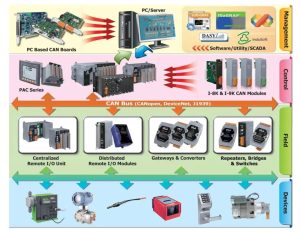
With decades of experience in CAN Bus technology, ICP DAS USA offers a comprehensive portfolio of CAN, DeviceNet, CANopen, and J1939 solutions. The product lineup includes PCI communication cards, fieldbus converters, PACs, gateways, and remote I/O modules, supporting a wide range of CAN-based applications such as data acquisition, signal processing, extended-distance communication, network integration, interface conversion, and noise reduction.
ICP DAS USA also provides a comprehensive selection of software tools and resources, including development tools, APIs, sample programs, OPC support, ActiveX components, and third-party drivers. These resources help users efficiently develop and integrate reliable CAN-based monitoring and control systems.
CAN Bus Converters
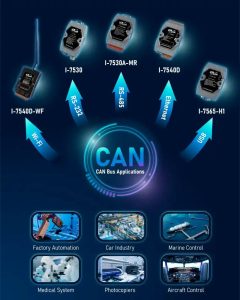
ICP DAS USA CAN Bus converters provide flexible communication between CAN Bus networks and other interfaces, including serial, USB, and Ethernet. By selecting the appropriate converter, users can easily connect and integrate devices that use different communication interfaces, simplifying system integration and expanding network flexibility.
CAN Series Programmable Automation Controllers (PACs)
ICP DAS USA offers a range of CAN-enabled Programmable Automation Controllers (PACs), including the I-7188XBD-CAN, uPAC-7186EXD-CAN, and uPAC-5001D-CAN2. These controllers support multiple communication interfaces, including CAN Bus, RS-232, RS-485, and Ethernet, providing flexible connectivity for a variety of industrial applications.
The PACs run on the MiniOS7 operating system, giving users the flexibility to develop customized applications using C/C++ programming environments. Their combination of versatile communication interfaces and programmable functionality makes them well suited for CAN-based data acquisition, monitoring, and control applications.
For more information about ICP DAS USA CAN Bus solutions, visit the CAN Bus product section on our official website.
Conclusion
ICP DAS USA provided a reliable and scalable solution that enhanced the integration and real-time monitoring of the vessel safety systems. By combining a comprehensive product portfolio with expert system planning, the solution helped improve overall equipment safety and system reliability.
ICP DAS USA also provides customized solutions tailored to specific application requirements, supporting customers across industries with flexible and integrated solutions.


