
Integrated Food Monitoring for Complete Traceability

Introduction
Growing food safety requirements have increased the need for accurate process monitoring and complete production traceability. A food manufacturer in Taiwan had multiple monitoring systems in place, but data was stored across separate platforms, making centralized management and traceability difficult.
To address this challenge, ICP DAS USA implemented an integrated monitoring solution that centralizes real-time data from powder weighing, machine utilization, oil tank overflow detection, environmental monitoring, access control, and control room systems. The result is a unified platform that improves operational visibility, supports regulatory compliance, and enables complete production traceability.
ICP DAS USA Integrated Monitoring Solution
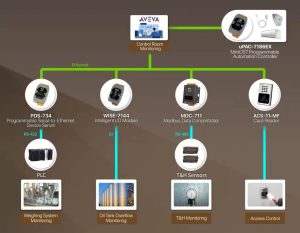
ICP DAS USA consolidated five key monitoring applications into a single SCADA platform:
By integrating all critical systems into a centralized platform, ICP DAS USA helps food manufacturers improve efficiency, strengthen quality control, and achieve end-to-end production traceability.
Weighing System Monitoring
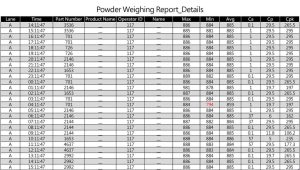
The PDS-734 Programmable Serial-to-Ethernet Device Server connects PLCs and other serial devices to the factory Ethernet network, enabling seamless communication with SCADA and HMI systems. In this application, the PDS-734 collects weighing data and machine availability information from the PLC and transmits it to the SCADA system for centralized monitoring, data logging, and production traceability.
Insert material filling room image here
Oil Tank Overflow Monitoring
The WISE-7144 Intelligent I/O Module monitors oil tank float level switches and sends real-time overflow status data to the SCADA system over Ethernet. Its built-in logic capabilities support reliable local control and alarm functions, helping improve operational safety while reducing system development effort.
Temperature and Humidity Monitoring
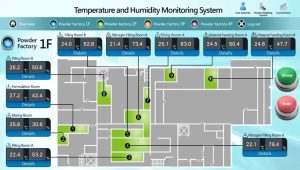
The MDC-711 Modbus Data Concentrator collects and consolidates data from multiple temperature and humidity sensors, then transmits the information to the SCADA system via Ethernet. By centralizing environmental data collection, the system simplifies management and improves monitoring efficiency across the facility.
Factory Access Control
The ACS-11-MF Proximity Card Reader with Keypad manages facility access and records personnel activity throughout the production process. Access records are automatically sent to the SCADA system, providing centralized management and enhanced production traceability by linking operators to specific manufacturing activities.
Control Room Monitoring
The DL-10 Temperature and Humidity Sensor continuously monitors environmental conditions in the control room to help maintain a stable operating environment for critical equipment.
The uPAC-7186EX-G Programmable Automation Controller (PAC) connects the control room’s environmental sensors, air conditioning system, and UPS equipment to the network, enabling centralized monitoring and data collection through the SCADA system.
Centralized Factory Management with AVEVA Edge
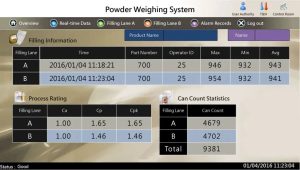
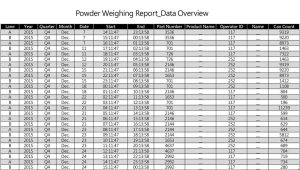
AVEVA Edge serves as the central monitoring platform, integrating data from weighing systems, production equipment, oil tank monitoring, environmental sensors, access control systems, and control room infrastructure into a single dashboard. This gives operators real-time visibility into factory operations, eliminates manual data consolidation, improves management efficiency, and supports complete production traceability.
Benefits
ICP DAS USA Energy Management Solution
As energy costs continue to rise and organizations focus on sustainability initiatives, understanding energy consumption has become essential for reducing operating expenses and meeting efficiency goals.
The ICP DAS USA Energy Management Solution (EMS) provides real-time monitoring of energy usage across critical facility systems, including cooling towers, chillers, HVAC equipment, lighting, and production machinery. By collecting and analyzing power consumption data, businesses can identify inefficiencies, implement targeted energy-saving measures, reduce unnecessary energy use, and lower electricity costs while supporting their energy and carbon-reduction objectives.
Factory Power Data Collection
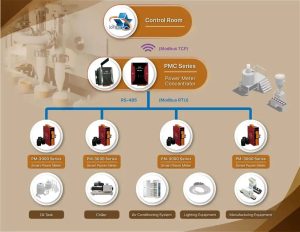
The PM-3000 Series Smart Power Meter accurately monitors power consumption across key equipment, including dryers, compressors, oil tank heaters, and mixing machines. Power usage data is transmitted via Modbus RTU to the PMC Series Power Meter Concentrator for centralized collection and analysis.
Edge-Based Power Monitoring and Control
The PMC Series Power Meter Concentrator consolidates power data from multiple devices, providing real-time monitoring and centralized energy management. Built-in edge computing capabilities enable automated alerts when abnormal voltage or current conditions are detected, helping maintenance teams respond quickly and reduce the risk of unexpected downtime. Collected data is forwarded to central monitoring systems via Modbus TCP for streamlined oversight.
Cloud Monitoring and Energy Visualization
IoTstar, ICP DAS USA’s IIoT cloud management platform, provides remote monitoring and visualization of energy consumption across the facility. Through an intuitive dashboard, users can view key metrics such as voltage, current, power factor, energy consumption (kWh), and estimated carbon emissions.
IoTstar also supports automated reporting in PDF and Excel formats, making it easy to track energy performance, identify inefficiencies, and evaluate energy-saving initiatives. Together, the PMC Series and IoTstar provide a complete solution for improving energy visibility and operational efficiency.
Conclusion
ICP DAS USA offers a comprehensive portfolio of industrial automation, system integration, and energy management solutions, including Serial-to-Ethernet Device Servers, Intelligent Edge Controllers, Modbus Data Concentrators, Programmable Automation Controllers (PACs), and Smart Power Meters.
For food manufacturers, ICP DAS USA enables centralized monitoring of production processes, environmental conditions, power consumption, access control, and critical facility equipment through a unified platform. By integrating previously isolated systems and data sources, manufacturers can improve operational visibility, strengthen production traceability, enhance quality control, reduce energy costs, and support food safety compliance.


