
Remote Water Flow Monitoring for Efficient Water Management
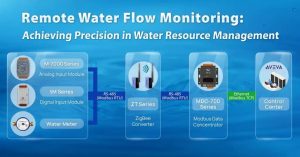
Managing Water Costs with Automated Monitoring
As climate change and rising supply costs drive water prices higher, businesses are under increasing pressure to manage water consumption efficiently. In Taiwan, for example, the government introduced additional water fees for high-volume users during dry seasons, increasing the need for proactive water resource management.
The client in this case is a high-water-consumption panel manufacturer producing TFT LCDs, LCD modules, and touch panel modules. Previously, employees manually collected data from water meters and flow meters located throughout the facility. This process was time-consuming, provided no real-time visibility, and increased the risk of recording errors.
To improve efficiency and accuracy, the client wanted an automated meter reading system that could monitor water usage in real time without modifying existing equipment or disrupting production. ICP DAS USA designed a wireless solution that minimized the need for new wiring while providing centralized monitoring of water pressure, flow rates, and water consumption across the facility.
ICP DAS USA Automated Water Monitoring Solution
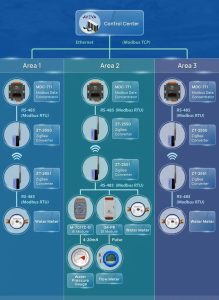
ICP DAS USA divided the facility into three monitoring areas and designed the system to meet the requirements of each location.
In Areas 1 and 3, existing water meters with Modbus communication directly provide cumulative water consumption data. The data is transmitted wirelessly through ZT-2550 and ZT-2551 ZigBee converters and then collected by MDC-711 Modbus Data Concentrators using Modbus RTU.
In Area 2, large-diameter water pipes are equipped with water meters, pressure gauges, and ultrasonic flow meters. The M-7017Z-G Analog Input Module collects water pressure data, while the tM-P8 Digital Input Module uses its built-in counter function to capture pulse signals from the ultrasonic flow meters.
The collected data is transmitted wirelessly through ZT-2550 and ZT-2551 ZigBee converters to the MDC-711 Modbus Data Concentrators. The MDC-711 units then transmit the consolidated data to the AVEVA Edge SCADA system in the central control room via Modbus TCP.
This architecture provides centralized, real-time visibility into water consumption across the facility, helping the client reduce manual data collection, improve measurement accuracy, identify consumption trends, and make more informed water management decisions without disrupting existing production operations.
System Architecture
The system architecture is shown below:
Water Pressure Data Collection
The M-7017Z-G Analog Input Module collects 4–20 mA signals from water pressure gauges and transmits the data to the ZT-2551 ZigBee RS-485/RS-232 Converter via Modbus RTU.
The M-7017Z-G provides 10 differential or 20 single-ended analog input channels, with independently configurable input ranges. It supports both voltage and current inputs, adjustable sampling rates, overvoltage and overcurrent protection, 4 kV ESD protection, and 3000 VDC isolation. It also supports Modbus RTU and DCON protocols, providing flexible and reliable data acquisition.
Ultrasonic Flow Meter Data Acquisition
The tM-P8 Digital Input Module operates as a counter to collect pulse signals from ultrasonic flow meters installed throughout the facility. The data is transmitted to the ZT-2551 ZigBee Converter via Modbus RTU.
With eight digital input channels, each supporting counter functionality, the tM-P8 provides reliable pulse data collection with photocoupler isolation, 4 kV ESD protection, and 3750 VDC isolation. It supports DCON, Modbus RTU, and Modbus ASCII protocols for flexible system integration.
ZigBee Wireless Data Transmission
The ZT-2551 ZigBee RS-485/RS-232 Converter and ZT-2550 ZigBee RS-485/RS-232 Converter provide wireless communication between field devices and the MDC-711 Modbus Data Concentrator, reducing the need for extensive wiring and simplifying installation.
Based on the IEEE 802.15.4 standard, ICP DAS USA ZigBee converters support RS-232 and RS-485 devices over a wireless network. The ZigBee series provides transmission distances of up to 700 meters line-of-sight, multiple RF channels, and scalable network configurations. The ZT-2000 Series can also function as a coordinator or router, helping extend wireless coverage and improve signal reliability.
Data Concentration
The MDC-700 Series Modbus Data Concentrators collect data from multiple Modbus RTU devices and make it available to Modbus TCP-based systems over Ethernet. This simplifies communication between field devices and centralized monitoring systems while reducing the time required to retrieve data.
The MDC-700 Series supports Ethernet, RS-232, and RS-485 interfaces, up to 8 Modbus TCP masters, and up to 250 configurable Modbus RTU commands. Its data-concentration capabilities allow multiple devices to be managed efficiently from a central system.
Remote Monitoring and Centralized Management
The AVEVA Edge SCADA system provides centralized monitoring of water pressure and flow rates through real-time displays and trend charts. It can also generate reports in CSV, PDF, and Excel formats, giving management teams the information needed for more effective water resource management.
AVEVA Edge provides an integrated SCADA and HMI platform with support for Windows-based runtime environments and remote web-based monitoring. This allows operators to access system information locally or remotely for greater flexibility and convenience.
Key Benefits
ICP DAS USA Wastewater Monitoring Solution for Factory Water Management
Effective wastewater monitoring is an important part of responsible factory water management. Real-time monitoring helps operators track wastewater discharge, identify potential leaks or abnormal conditions, and support compliance with environmental requirements. Combining monitoring with wastewater recycling can also improve water utilization and reduce operating costs.
ICP DAS USA has implemented a wastewater monitoring solution in a piston rod manufacturing facility. WISE Series Intelligent Edge Controllers collect data from water quality analyzers, differential pressure gauges, and flow meters installed across multiple buildings and floors. The data is transmitted via Ethernet to an AVEVA Edge SCADA system in the control center, where operators can monitor water quality, differential pressure, and flow rates throughout the facility.
If an abnormal condition occurs, the WISE controllers can automatically trigger alerts through email, Telegram, or WeChat using built-in IF-THEN-ELSE logic. This allows the system to respond immediately at the source rather than waiting for instructions from the central control room.
Together, these technologies provide ICP DAS USA’s scalable water and wastewater monitoring solution, helping factories improve visibility, reduce manual inspections, detect problems earlier, and make better use of valuable water resources.
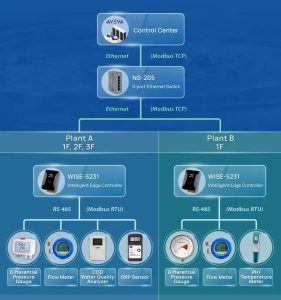
The ICP DAS USA WISE Series Intelligent Edge Controller provides reliable edge logic control and monitoring for a wide range of industrial applications. Its built-in IF-THEN-ELSE logic enables automated control while supporting calculations, scheduling, and alarm notifications through email, Telegram, or WeChat.
The WISE Series features a user-friendly web interface that allows operators to configure automation rules without programming. Its built-in data logger also includes a data recovery function. If network communication is interrupted, data is temporarily stored on the controller’s SD card and automatically uploaded to the database once the connection is restored, helping maintain complete and reliable historical data.
Conclusion
As ESG initiatives continue to grow, businesses are placing greater emphasis on energy and water efficiency. In addition to ISO 50001:2018 for energy management, ISO 46001 provides a framework for improving water efficiency and supporting more sustainable water use.
ICP DAS USA provides a broad range of water resource management technologies for applications spanning dams and rivers, water treatment facilities, cities, factories, and wastewater treatment systems. Our portfolio includes sensors, IP cameras, I/O modules, alarm devices, programmable automation controllers (PACs), edge controllers, HMIs, and LED displays.
By combining flexible hardware, reliable communication, automation, and monitoring technologies, ICP DAS USA helps customers improve water efficiency, reduce resource waste, strengthen operational visibility, and support their ESG and sustainability goals.
For more water resource management applications, see “Strengthening Climate Resilience: ICP DAS Water Resource Management Solutions.”


