
GPS Fleet Management for Alishan Electric Buses
Application Overview
The Alishan National Forest Recreation Area in Taiwan is located at an altitude of approximately 2,216 meters. Electric buses are used to provide transportation within the recreation area as part of the park’s environmentally focused transportation program.
Because Alishan is located at high altitude and experiences high humidity, terrain and weather conditions can reduce electric-bus driving range and battery life. The control center wanted to monitor the charging and aging process of the batteries, driving distance, vehicle location, and battery level while the buses were operating.
ICP DAS USA’s solution collects battery and vehicle information from the electric-bus fleet and transmits it to the control center for real-time monitoring, fleet management, vehicle dispatching, historical review, and reporting.
The Challenge
Fleet personnel needed centralized access to battery-condition and vehicle-operating information from buses moving through a wide outdoor area. The system had to collect battery voltage and temperature, track each bus by GPS, transmit data over a cellular network, and provide historical information and reports for fleet management.
The remote communication system also needed automatic reconnection and a practical way to handle cellular devices that may use dynamic IP addresses while still communicating with the fixed monitoring terminal at the control center.
The ICP DAS USA’s Solution
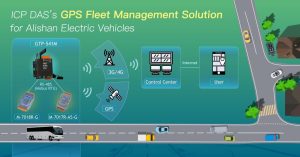
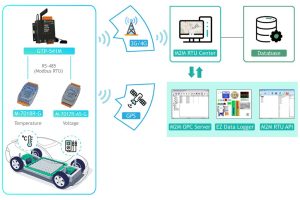
The solution is divided into two parts: the electric bus fleet and the control center. On each bus, the M-7017R-A5-G and M-7018R-G collect battery information and send it to the GTP-541M series remote controller through Modbus RTU over RS-485. The GTP-541M combines this information with GPS and other vehicle data and sends it to the control center through 3G/4G wireless communication.
Battery Voltage Monitoring
The M-7017R-A5-G is an 8-channel high-voltage analog input module used to acquire battery voltage. It supports ±50 V and ±150 V input ranges and communicates using Modbus RTU over RS-485. The module provides high over-voltage and common-voltage protection, 4 kV ESD protection, and 3000 VDC intra-module isolation.
Battery Temperature Monitoring
The M-7018R-G is an 8-channel thermocouple input module with high-voltage protection. In addition to thermocouple inputs, it supports current and voltage inputs, including a ±2.5 V range. In this application it collects battery temperature data and transmits the information to the GTP-541M through Modbus RTU over RS-485.
The M-7018R-G provides high over-voltage and common-voltage protection, 4 kV ESD protection, and 3000 VDC intra-module isolation. Current product specifications list overvoltage protection up to 240 Vrms.
GPS, Vehicle Data, and 3G/4G Communication
The GTP-541M is a multifunctional 4G controller with built-in GPS and a processor that can perform real-time logic control for connected I/O modules. In this application it receives voltage data from the M-7017R-A5-G, temperature data from the M-7018R-G, data from Modbus devices, and GPS location information.
The transmitted vehicle dataset includes vehicle speed, rotating speed of the motor, battery information, daily mileage, and real-time vehicle location. The GTP-541M sends the collected information to the remote management system through 3G/4G communication using the ICP DAS USA’s RTU protocol.
The GTP-541M supports automatic reconnection. The original application also describes the remote controller operating with a dynamic IP while connecting to the fixed-IP monitoring terminal running M2M RTU Center, simplifying remote device IP management.
Data can be transmitted at scheduled times or when an event triggers transmission. Using scheduled and event-triggered reporting helps reduce unnecessary host communication and improves data-transfer efficiency when multiple remote stations are connected.
Control Center and Fleet Management
M2M RTU Center management software receives the information transmitted by the GTP-541M controllers. It can monitor local I/O data, local GPS data, and I/O data from connected Modbus RTU modules. The licensed version supports management of up to 1,024 M2M RTU devices.
The original application uses the term M2M RTU API SDK for the software development package. It supports development environments such as VC, VB, BCB, and Visual Studio .NET so developers can integrate M2M RTU data into user-developed applications or SCADA systems.
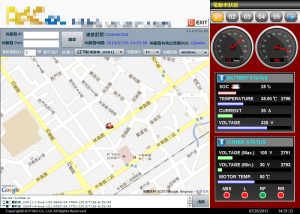
Management personnel can access the fleet-management web page from a computer or smartphone browser to view real-time vehicle location and driving status and query vehicle history. The system can provide fleet performance reports, mileage statistics, and anomaly reports for overspeed, idling, and I/O module status.
Vehicle locations are displayed on a map and updated dynamically. The solution can also use SMS notifications to alert management personnel when an emergency or abnormal condition occurs.
EZ Data Logger Integration
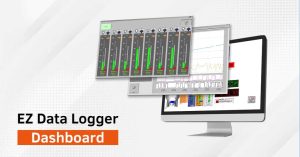
M2M RTU Center can be used with ICP DAS USA’s EZ Data Logger. Data transmitted by the GTP-541M can be stored in a database and displayed on an EZ Data Logger dashboard, providing a way to build a real-time data acquisition and monitoring system without custom programming.
System Architecture
Electric-Bus Battery / Vehicle Data
↓
M-7017R-A5-G High-Voltage Analog Input
M-7018R-G Thermocouple Input
↓ Modbus RTU over RS-485
GTP-541M 4G Controller with GPS
↓ 3G/4G + ICP DAS USA’s RTU Protocol
M2M RTU Center + M2M RTU API SDK
↓
Fleet-Management Application / SCADA / EZ Data Logger
How the System Works
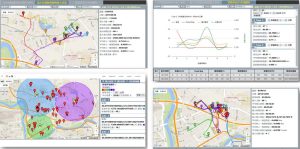
Fleet-management software or EZ Data Logger can display, store, analyze, and report the collected information.
Key Benefits
Conclusion
This application combines high-voltage battery monitoring, thermocouple temperature measurement, GPS positioning, 3G/4G communication, and centralized fleet-management software to provide real-time visibility into Alishan’s electric-bus fleet.
Battery voltage and temperature data are collected through M-7000 series I/O modules, while the GTP-541M combines the field data with GPS and other vehicle information and sends it to the control center. Fleet personnel can monitor vehicle location and driving status, review historical information, generate mileage and anomaly reports, and receive SMS alerts when abnormal conditions occur.


