
Smarter Predictive Maintenance: Greater Efficiency and Transparency
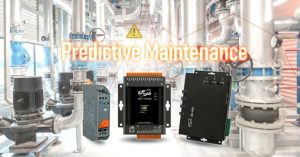
To implement a predictive maintenance strategy, consider the following:
To support these efforts, ICP DAS USA provides smart predictive maintenance solutions that improve equipment monitoring, operational efficiency, and data visibility.
PET-7H16M High-Speed Data Acquisition Module
The PET-7H16M is a high-speed data acquisition module with built-in Ethernet connectivity for reliable network data transmission. It features eight high-speed analog input channels and supports simultaneous 16-bit A/D conversion on each channel, with sampling rates of up to 200,000 samples per second.
The module also supports synchronous data acquisition, ensuring accurate and consistent data collection across all input channels. Each channel includes an integrated A/D converter with anti-aliasing filtering to optimize sampling performance and reduce noise.
With its high-speed performance and measurement accuracy, the PET-7H16M is well suited for predictive maintenance, industrial monitoring, portable measurement systems, and precision signal acquisition applications.
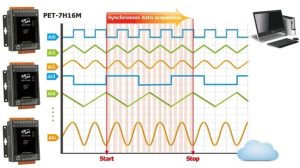
The PET-7H16M supports continuous data acquisition, N-sample acquisition, and simultaneous multi-channel acquisition, making it ideal for a wide range of high-speed monitoring and measurement applications.
Each analog input channel supports sampling rates of up to 200 kHz, enabling accurate data collection from various mechanical, electrical, and physical signals. This makes the module well suited for applications in industrial automation, process control, electrochemistry, medical systems, and other precision measurement environments.
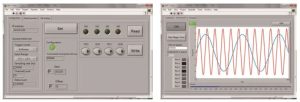
To simplify system integration and data management, ICP DAS USA also provides a host PC utility with comprehensive development support. The utility includes APIs for Visual C++, C#, and VB.NET, as well as compatibility with LabVIEW, allowing users to quickly develop, manage, and analyze data acquisition applications.
Enhance Predictive Maintenance with Real-Time Monitoring
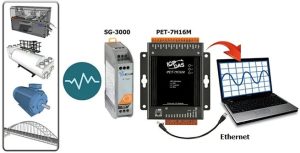
ICP DAS USA combines the SG-3000 Series Signal Conditioning Modules with the PET-7H16M to create a powerful predictive maintenance solution.
The SG-3000 Series supports a wide range of sensors, including current, voltage, temperature, strain, and vibration sensors. By filtering and conditioning sensor signals, it ensures accurate data collection and analysis.
Paired with the PET-7H16M, the solution enables real-time monitoring of equipment across multiple locations and transmits critical data to a central management system via Ethernet. This helps organizations improve equipment visibility, detect issues early, and make smarter maintenance decisions.
High-Performance Vibration Monitoring with the AR-200/AR-400
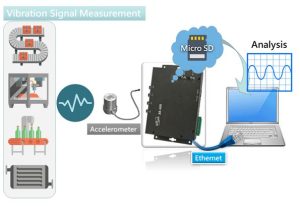
The AR-200 and AR-400 dynamic signal acquisition modules from ICP DAS USA are designed for vibration monitoring and predictive maintenance applications.
Supporting simultaneous sampling rates of up to 200 kHz (AR-200) and 125 kHz (AR-400) per channel, these modules deliver accurate, high-speed data collection for vibration analysis. They also feature built-in IEPE accelerometer excitation and 16-bit A/D conversion for reliable signal measurement.
Captured data can be stored directly on a MicroSD card for offline analysis, making the AR-200/AR-400 an ideal solution for machine condition monitoring, fault detection, and predictive maintenance programs.
Easy Configuration for Vibration Monitoring
ICP DAS USA provides a PC-based utility that simplifies setup and operation of the AR-200/AR-400 modules. Users can easily configure triggering modes, adjust sampling rates, and schedule data collection to meet the requirements of different monitoring applications.
With their high-speed performance, flexible configuration options, and support for detailed vibration analysis, the AR-200/AR-400 modules are an ideal choice for machine condition monitoring and predictive maintenance.
Conclusion
ICP DAS USA’s predictive maintenance solutions help improve maintenance efficiency, equipment visibility, and operational reliability. By identifying potential issues before failures occur, maintenance teams can make informed decisions, extend equipment life, reduce downtime, and enhance plant safety.


