
Optimizing Semiconductor Storage with ZigBee Temperature & Humidity Monitoring
Introduction
The customer manufactures high-tech semiconductor packaging materials that are highly sensitive to temperature and humidity fluctuations. Prolonged exposure to excessive humidity can cause deliquescence, compromising product quality. As a result, continuous monitoring of warehouse temperature and humidity is critical for quality control and compliance with inspection requirements.
Previously, warehouse conditions were monitored through manual inspections and paper-based records. This approach was prone to errors, such as inaccurate data entry and delayed detection of abnormal temperature or humidity levels. To improve reliability, the customer sought an automated monitoring system that could collect, store, and analyze environmental data in real time while providing immediate alerts when abnormal conditions occurred.
A further challenge was the facility’s layout, which included six large storage warehouses distributed across the plant. Implementing traditional wired communications would have been costly and difficult to deploy. To address this issue, the customer adopted ICP DAS USA’s ZigBee wireless solution for warehouse environmental monitoring. The solution enables reliable, around-the-clock temperature and humidity monitoring across multiple warehouses, with automatic notifications whenever abnormal conditions are detected.
ICP DAS USA’s ZigBee Wireless Solution for Temperature & Humidity Monitoring
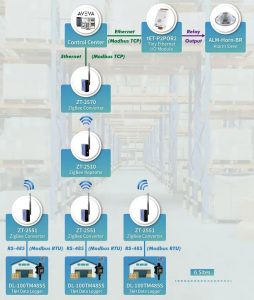
In this application, each of the six warehouses is equipped with a DL-100TM485S Temperature & Humidity Data Logger. Temperature and humidity data is collected and transmitted via the Modbus RTU protocol to a
ZT-2551 RS-232/RS-485 to ZigBee Converter.
The data is then transmitted wirelessly through the ZigBee network to a ZT-2510 ZigBee Repeater, which forwards it to a ZT-2570 Ethernet/RS-232/RS-485 to ZigBee Converter. From there, all information is sent to the control center using the Modbus TCP protocol.
At the control center, AVEVA Edge SCADA provides centralized data logging, analysis, and trend visualization. The system continuously monitors temperature and humidity levels against predefined high and low alarm thresholds. If a threshold is exceeded, AVEVA Edge activates the ALM-Horn-BR Alarm Siren through the tET-P2POR2 Tiny Ethernet I/O Module and automatically sends email notifications to management personnel. This allows problems to be identified and addressed quickly, helping maintain optimal storage conditions and protect product quality.
The system architecture is shown below:
Solution Overview
The DL-100TM485S Temperature & Humidity Data Logger records temperature, humidity, and dew point data through an RS-485 communication interface. Its built-in LCD display shows temperature, humidity, dew point, and module ID, while onboard storage can retain up to 4,088 records. In this application, six DL-100TM485S units are installed, one in each warehouse, to continuously monitor environmental conditions and transmit data using the Modbus RTU protocol.
Reliable ZigBee Wireless Communication
ZigBee is a wireless personal area network (WPAN) technology based on the IEEE 802.15.4 standard. Designed for industrial monitoring and control applications, it supports communication distances ranging from 10 to 700 meters while offering low power consumption, strong interference resistance, high security, and cost-effective deployment.
ICP DAS USA’s ZigBee product family complies with IEEE 802.15.4 and ZigBee Pro (ZigBee 2007) standards, providing reliable wireless communication for industrial environments.
In each warehouse, a ZT-2551 RS-232/RS-485 to ZigBee Converter receives temperature and humidity data from the DL-100TM485S logger and converts the RS-485 communication to ZigBee wireless transmission.
The data is then forwarded to a ZT-2510 ZigBee Repeater, which extends wireless coverage and collects data from multiple warehouses. From there, the information is sent to a ZT-2570 Ethernet/RS-232/RS-485 to ZigBee Converter located in the central control room. The ZT-2570 transmits the data to the host system using Modbus TCP, eliminating the need for extensive plant-wide wiring.
Centralized Monitoring and Alarm Management
Once the data reaches the control center, AVEVA Edge SCADA provides centralized monitoring, data logging, historical trending, and reporting. Operators can visualize temperature and humidity trends in real time and export data in CSV, PDF, or Excel formats for further analysis and compliance documentation.
The platform also supports customizable alarm thresholds. If temperature or humidity levels exceed predefined limits, AVEVA Edge automatically activates the ALM-Horn-BR Alarm Siren through the tET-P2POR2 Tiny Ethernet I/O Module, providing immediate visual and audible alerts. At the same time, email notifications can be sent to designated personnel for rapid response.
The tET-P2POR2 features two digital inputs and two photoMOS relay outputs and supports Modbus TCP/UDP and MQTT protocols. Its compact design allows flexible installation, while built-in watchdog functions help ensure reliable operation. In this application, the module serves as the interface between AVEVA Edge and the alarm siren, enabling automatic alert activation whenever abnormal environmental conditions are detected.
Benefits
Wireless Installation and Reduced Cabling Costs
ZigBee wireless modules convert RS-485 communication into wireless signals, eliminating the need for costly wiring between warehouses and the control room. ZigBee mesh networking automatically routes data through alternate paths when obstacles or interference occur, ensuring reliable communication.
Flexible ZigBee Product Ecosystem
ICP DAS USA offers a wide range of ZigBee communication products to support different applications, including I/O Pair modules, data concentrators, network bridges, and wireless converters, enabling flexible system expansion and integration.
Powerful SCADA Visualization and Reporting
AVEVA Edge SCADA provides an intuitive interface with customizable dashboards, historical trending, alarm management, multi-language support, database connectivity, and report generation capabilities.
Easy Integration with Industrial Systems ICP DAS USA’s I/O modules support standard Modbus communication, allowing seamless integration with SCADA systems, PLCs, and other industrial devices.
Compact and Versatile Ethernet I/O
The tET-P2POR2 Tiny Ethernet I/O Module is small enough to be installed almost anywhere, including inside equipment enclosures, simplifying deployment and maintenance.
Enhanced System Reliability
Built-in CPU and Host watchdog functions help maintain stable operation by automatically recovering from communication or firmware issues. Pair-connection functionality also enables direct transmission of digital signals without additional programming.
Scalable I/O Solutions
The tET Series is ideal for smaller applications, while the ET-70xx, ET-72xx, and ET-22xx Series provide scalable options for larger and more complex deployments.
Immediate Alarm Notification
The ALM-Horn-BR Alarm Siren offers multiple alarm tones and integrated LED indicators, providing clear visual and audible warnings whenever critical environmental conditions occur.
ICP DAS USA’s Wireless Environmental Monitoring Solution
ICP DAS USA offers a comprehensive wireless environmental monitoring solution that combines temperature and humidity monitoring, leak detection, energy management, and access control into a unified platform.
The solution includes:
Data from these devices can be consolidated and transmitted to the control center using the MDC-700 Series Modbus Data Concentrators and PMC-2241M Power Meter Concentrator. Operators gain real-time visibility into environmental conditions, energy usage, leak detection status, and facility access information.
For centralized visualization and management, ICP DAS USA’s IoTstar IIoT Cloud Management Software enables users to monitor, analyze, and manage data from the control center through a single, easy-to-use interface.
Additional Environmental Monitoring Applications
Leak Detection
The iSN-101/S2 Liquid Leakage Detection Module, paired with the CA-LLD-DC Liquid Leakage Detection Cable, provides reliable detection of water leaks and pipeline failures. When a leak is detected, the system immediately reports the event to the control center and notifies responsible personnel, enabling a faster response and minimizing potential damage.
Power Consumption Monitoring
The ICP DAS USA PM-3133-100 Three-Phase Smart Power Meter delivers high-accuracy energy monitoring for factory equipment and facility infrastructure. Real-time power consumption data is transmitted to the control center, providing visibility into energy usage and supporting more effective energy management.
Access Control Management
The tM-PD3R3 Digital Input and Power Relay Module captures data from card reader access systems and communicates it to the PMC-2241M Power Meter Concentrator. When access credentials are verified, the PMC-2241M commands the tM-PD3R3 to unlock the door. If an access attempt fails, the system automatically sends an alarm notification to designated personnel.
Modbus Data Concentration with ZigBee Connectivity
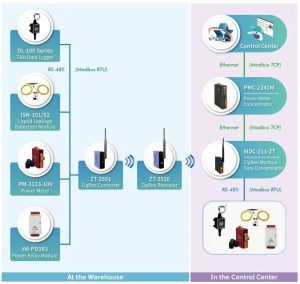
The MDC-211-ZT Modbus Data Concentrator combines data logging capabilities with support for Ethernet, RS-232, RS-485, and ZigBee communications. It simplifies integration between Modbus RTU and Modbus TCP networks while consolidating data from multiple devices into a unified address map, reducing polling requirements and improving communication efficiency.
In this application, the MDC-211-ZT wirelessly collects temperature, humidity, leakage, and power consumption data from ZT Series ZigBee devices while also gathering information from RS-485-connected devices. All data is then transmitted via Ethernet to the PMC-2241M Power Meter Concentrator for centralized monitoring and management.
Edge Computing and Intelligent Control
The PMC-2241M Power Meter Concentrator serves as a powerful edge controller for energy management and facility monitoring. It supports real-time data collection, data logging, web-based configuration, and integration with a wide range of communication protocols.
Using built-in IF-THEN-ELSE logic, the PMC-2241M can automatically respond to abnormal operating conditions. The system can trigger alarms and send notifications through Email, SMS, LINE, or WeChat when thresholds for voltage, current, temperature, humidity, or other critical parameters are exceeded.
In addition to consolidating power consumption data, the PMC-2241M gathers environmental monitoring, leak detection, and access control data and forwards it to ICP DAS USA’s IoTstar IIoT Cloud Management Software using the Modbus TCP protocol.
Data Visualization and Cloud Management
IoTstar is ICP DAS USA’s IIoT cloud management platform for remote monitoring and management of WISE, PMC, and PMD series controllers, as well as connected I/O modules and field devices.
With the IoTstar Dashboard Service, users can create customized dashboards tailored to their operational requirements and share them across teams. The platform also includes a Report Service that provides statistical analysis, historical data queries, and automated report generation. Reports can be exported in PDF or Excel format for further analysis, documentation, and decision-making.
Key Benefits
Conclusion
ICP DAS USA’s ZigBee-based temperature and humidity monitoring solution provides real-time visibility into warehouse conditions while eliminating the need for extensive wiring. The system continuously collects and analyzes environmental data, automatically generating alarms when abnormal conditions occur, helping protect product quality and ensure regulatory compliance.
By combining wireless communication, centralized monitoring, and automated alerts, the solution reduces maintenance costs, improves operational efficiency, and supports accurate recordkeeping for quality assurance and inspections.
With a broad portfolio of wireless communication and industrial automation products, ICP DAS USA delivers scalable solutions that help organizations enhance monitoring, streamline operations, and advance their smart factory initiatives.


