
Real-Time Emergency Alerts with ZigBee Technology
Introduction
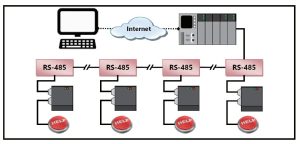
Traditional campus security systems often rely on alarm buttons connected only to a local buzzer. In an emergency, security personnel may not be notified immediately because alarm information is not automatically transmitted to the security center.
Extending alarm coverage across multiple locations typically requires additional wiring to the security center, which can significantly increase installation costs, especially when buildings are spread across a large campus.
To address these challenges, ICP DAS USA offers a ZigBee wireless emergency alarm solution that eliminates complex wiring, reduces installation costs, and enables real-time alarm transmission to the security center for faster response and improved safety.
The ZT-IOG System for Emergency Alarm Applications
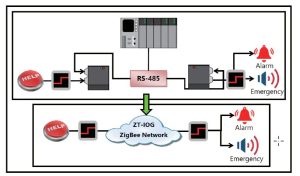
The ZT-IOG system from ICP DAS USA is an ideal solution for emergency alarm applications. Using ZigBee wireless communication, the system automatically detects changes in digital I/O (DIO) status and instantly sends notifications to the message center (ZigBee Coordinator).
The message center then synchronizes the status across all connected DO channels within the ZT-IOG network, enabling immediate activation of alarms and alerts. This wireless approach provides fast, reliable emergency notifications while reducing wiring requirements and simplifying system deployment.
ZigBee Network Emergency Alarm System
Application Overview
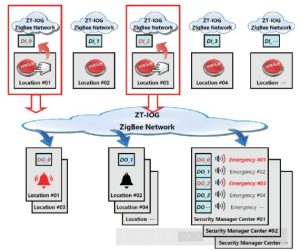
Emergency alarm stations are often installed throughout a facility, and each alarm must be able to instantly notify the security center when activated. ICP DAS USA’s ZT-IOG modules use a ZigBee wireless network with multi-to-multi I/O pairing, allowing alarms from any location to automatically send event notifications to the message center.
When an alarm is triggered, the ZT-IOG network synchronizes the corresponding digital output (DO) channels across connected modules, enabling immediate activation of alarms, warning lights, or other response devices. Using Pulse Mode control logic, organizations can deploy alarms across multiple locations and connect them to multiple security centers, surveillance systems, or notification devices for faster and more effective emergency response.
This wireless architecture reduces wiring costs, simplifies installation, and provides a scalable solution for campus, building, and facility-wide emergency alarm applications.
ZigBee Network Emergency Alarm System Architecture
Event Triggering Modes
ICP DAS USA’s ZT-IOG modules support multiple event-triggering modes, making it easy to adapt the system to different application requirements.
Edge Mode is ideal for use with momentary push buttons in lighting control and alarm systems. When the button is pressed, the system detects the signal change and can simultaneously trigger multiple connected devices, such as lights, alarms, or notification equipment.
This flexible event-triggering capability allows organizations to build responsive ZigBee wireless control systems while reducing wiring complexity and simplifying installation.
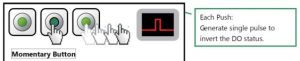
Momentary Button
Level Mode is well suited for fire safety and emergency alarm systems that use a standard push button. When activated, the alarm remains active until it is manually released from the same location, ensuring that emergency notifications stay visible and audible until the situation has been addressed.
This functionality helps provide reliable emergency response, clear alarm status indication, and simplified operation for building and facility safety systems.
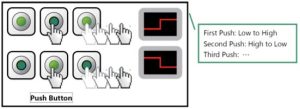
Push Button
An emergency push button is designed to lock in place when pressed and requires a key to reset. This feature helps prevent accidental or unauthorized deactivation, ensuring that emergency alerts remain active until the situation has been properly addressed.
ICP DAS USA’s ZT-IOG modules can use these emergency buttons as reliable alarm triggers, providing immediate notification and helping ensure that critical alarms cannot be easily disabled during an emergency.

Emergency Button


