
Improve EV Charging Station Reliability with Intelligent Remote Monitoring
Introduction
South Korea is rapidly expanding its EV charging infrastructure, with plans to install hundreds of thousands of charging stations nationwide. As the market for electric vehicles, charging networks, and renewable energy continues to grow, reliable monitoring and maintenance have become increasingly important.
In this case, a leading South Korean EV charger manufacturer and supplier needed a more efficient way to manage charging stations distributed across the country. Routine on-site inspections required significant time and labor. By implementing the ICP DAS USA EV Charging Station Monitoring Solution, maintenance teams can now remotely monitor the real-time status of each charger, reducing operating costs and improving resource allocation.
The solution also uses fiber-optic communications, which are immune to electromagnetic interference from high-current charging equipment. This ensures stable data transmission while extending communication distances between charging stations and control centers.
ICP DAS USA EV Charging Station Monitoring Solution
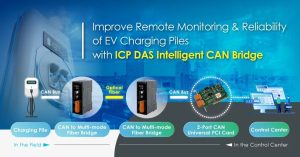
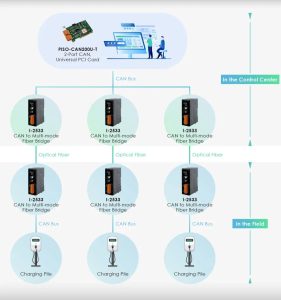
Status data from each EV charging station is collected through the CAN bus and transmitted to the I-2533 CAN-to-Multi-Mode Fiber Bridge. The data is then sent over a fiber-optic network to a second I-2533 module before being delivered to the PISO-CAN200U-T PCI Card installed in the central controller.
This architecture enables real-time remote monitoring, extends communication distances, minimizes the impact of electromagnetic interference, and ensures reliable data transmission across the EV charging network.
The ICP DAS USA I-2533 CAN-to-Multi-Mode Fiber Bridge converts CAN bus signals to fiber-optic communications, enabling reliable long-distance data transmission. Using a pair of I-2533 modules, two CAN networks can be connected even when operating at different baud rates. The module supports CAN 2.0A and 2.0B standards and can connect up to 100 CAN devices.
Because communication is transmitted over fiber optics, network performance is not affected by CAN baud rates, allowing distances of up to 2 km. Fiber-optic isolation also helps prevent faults on one CAN network from affecting another, improving overall system reliability.
The I-2533 includes an easy-to-configure message filtering function that simplifies communication between CAN networks using different baud rates. In this EV charging application, the bridge transfers charger status data through a fiber-optic network to the PISO-CAN200U-T PCI Card installed in the central controller.
The PISO-CAN200U-T PCI Card features two independent CAN channels and supports configurable baud rates from 10 kbps to 1 Mbps. Compatible with CAN 2.0A and 2.0B, it provides built-in arbitration, error detection, automatic recovery, and message retransmission. The card also supports popular software platforms such as SocketCAN, LabVIEW, DASYLab, and RTX, making it suitable for a wide range of CAN applications. In this solution, it receives EV charger data transmitted by the I-2533 bridge.
Benefits
ICP DAS USA Intelligent CAN-to-Ethernet Solution
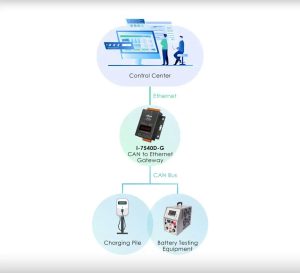
ICP DAS USA also offers CAN-to-Ethernet solutions for applications that require efficient remote monitoring over Ethernet networks. The I-7540DM CAN-to-Ethernet Gateway combines CAN and Ethernet (Modbus TCP/IP) interfaces, enabling field devices to communicate directly with a central monitoring system.
This approach is ideal for installations where the distance between field equipment and the control center is relatively short. The solution has been successfully deployed for battery testing equipment power monitoring in Taiwan and EV charging station monitoring projects in Spain, delivering reliable and cost-effective data communications.
Conclusion
With the ICP DAS USA EV Charging Station Monitoring Solution, operators can remotely monitor the status of EV charging equipment in real time. When issues occur, maintenance teams can quickly identify and respond to problems, reducing downtime, minimizing service visits, and lowering operating costs.
As EV adoption continues to accelerate, the demand for reliable charging infrastructure and battery monitoring solutions will continue to grow. ICP DAS USA provides dependable, flexible, and scalable technologies that help organizations meet these evolving requirements.
Beyond EV charging applications, ICP DAS USA delivers innovative solutions for energy management, IIoT, smart manufacturing, building automation, smart agriculture, transportation, and environmental monitoring, helping customers improve efficiency, reliability, and operational visibility across a wide range of industries.


