ZigBee Routing System for Automated Guided Vehicles (AGVs)
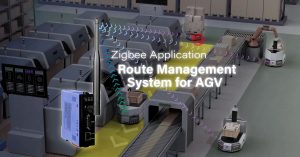
Description
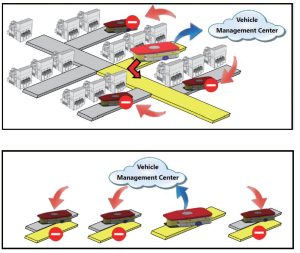
When an AGV needs to enter a restricted area, such as a roadway, track, or elevator, it first requests permission from the vehicle management center. Once access is approved, the area is reserved until the AGV leaves, preventing route conflicts and ensuring safe operation.
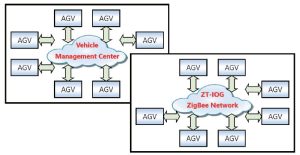
Using a wireless M2M communication architecture, AGVs exchange real-time status updates with the vehicle management center and nearby vehicles, enabling efficient route coordination and smooth traffic flow.
The ZT-IOG System is Suitable for the AGV Route Management System
Event-Driven Communication
The ZT-IOG network uses a many-to-many I/O connection architecture, allowing any connected ZT-IOG module to update the I/O status of other modules on the ZigBee network. This capability makes it ideal for AGV route management by enabling fast, reliable message exchanges between vehicles.
Real-Time Message Exchange
Before entering a restricted area, an AGV must first check whether the area is available and then update its status. The system uses simple digital I/O states to represent area conditions:
By sharing these status updates across the ZigBee network, AGVs can instantly determine whether a route is available and avoid conflicts with other vehicles.
System Architecture
The AGV route management solution consists of two main layers:
Control Layer
Each AGV is equipped with a PLC, PAC, IPC, or similar controller. In addition to managing vehicle movement and material handling, the controller monitors route status and coordinates communication with other AGVs to ensure safe access to restricted areas.
Communication Layer
The ZT-IOG ZigBee network serves as the communication backbone, enabling AGVs to exchange route status information wirelessly. Area availability is represented through I/O status signals, which are automatically synchronized across the network, eliminating the limitations of hardwired communication.
How It Works
When an AGV requests access to a restricted area, its controller sends an occupancy signal through the ZT-IOG module. This status is instantly shared with all other AGVs on the ZigBee network, marking the area as occupied and preventing additional vehicles from entering.
Once the AGV leaves the restricted area, the occupancy signal is cleared, and the area is marked as available. Other AGVs can then request access, ensuring smooth traffic flow, preventing route conflicts, and improving overall system efficiency.
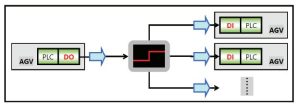
Message Exchange
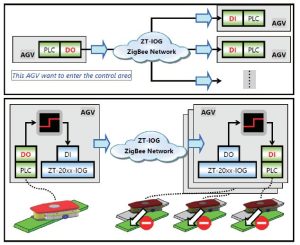
The Actual Operation
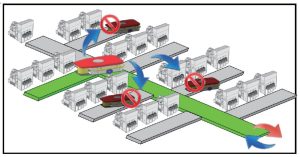
Overall Architecture Diagram
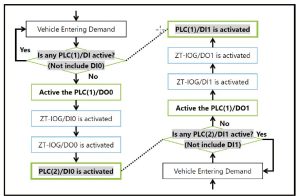
Application Architecture (II)
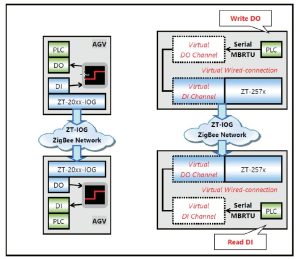
In addition to using the physical I/O channels on ZT-20xx-IOG modules to represent occupied and available status signals, AGV systems can also exchange messages through the PLC’s serial communication interfaces, including RS-232 and RS-485.
The ZT-257x series extends this capability by providing up to 280 pairs of virtual digital I/O channels that can be accessed using the Modbus RTU protocol. These virtual channels can operate alongside physical I/O channels in pair-connection mode, enabling flexible and scalable communication between AGVs and control systems.
This approach allows route status, access requests, and other operational messages to be exchanged without relying solely on physical I/O signals, providing greater versatility for complex automation applications.
Key Benefits
Combines wired and wireless communication for greater scalability