
Stack Light Monitoring for CNC Machining Production Lines
Application Overview
An aluminum alloy manufacturer wanted to improve how it monitored CNC machining production lines. Previously, personnel inspected the machines on-site and manually recorded machine performance. The customer wanted to reduce manual recording errors, improve production efficiency, and manage machine performance from a central location.
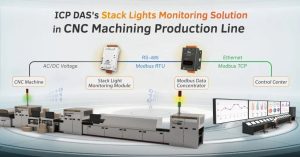
ICP DAS USA provided a stack light monitoring solution that collects machine-status information from the CNC equipment and sends it to a central control computer. This gives management personnel a unified way to monitor machine conditions and respond when abnormal conditions occur.
The Challenge
The customer needed a practical way to monitor CNC machine status without relying on repeated on-site inspections. The system also needed to reduce manual data collection, support remote monitoring, and provide timely machine-status information so personnel could respond more quickly to production issues.
The ICP DAS USA Solution
Stack Light Monitoring at Each CNC Machine
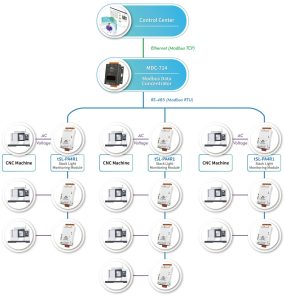
Ten CNC machines were each equipped with one tSL-PA4R1 stack light monitoring module. The modules read the status of the machine stack lights and collect the information needed to identify machine operating conditions.
Centralized Data Collection
All ten tSL-PA4R1 modules send their data to the same MDC-714 Modbus Data Concentrator through Modbus RTU. The MDC-714 combines the information and then sends the collected data to the control center over Modbus TCP, allowing machine-status information from the production line to be managed from one location.
The MDC-714 provides four RS-485 ports, with each port supporting up to 32 Modbus slave devices. This gives one MDC-714 enough capacity to receive stack light data from more than 100 tSL-PA4R1 modules when required.
Machine Status Monitoring
The stack light monitoring modules can detect whether individual stack light signals are on, off, or flashing. Users can also define combinations of light signals to represent conditions such as operating, idle, processing, or error states. This allows machine status to be represented directly instead of requiring each light signal to be interpreted separately.
Historical Data and Network Communication
The modules can report historical light-status information by time period, helping users determine how long machines spend operating, processing, troubleshooting, or remaining idle. This information can also support integration with MES and ERP systems for machine-availability calculations and production analysis.
In addition to Modbus communication, the stack light monitoring modules support MQTT. Instead of relying only on repeated polling, changes in machine status can be sent back to the control center, helping reduce network traffic.
Web and CSV Configuration
The stack light monitoring modules and MDC series data concentrators include web-based configuration. Users can access configuration functions through a web browser without additional programming tools. The MDC series also supports CSV-based configuration, allowing Modbus RTU command settings to be edited and imported for easier management of multiple devices. Comments can be added to the command settings, and configuration files can be password protected.
EZ Data Logger Integration
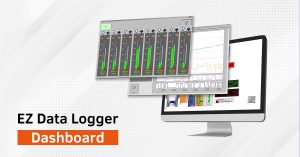
The MDC-714 can also be integrated with ICP DAS USA’s EZ Data Logger software. Data received by the MDC-714 can be stored in a database and displayed on an EZ Data Logger dashboard, providing a simple way to build a real-time data acquisition and monitoring system without programming.
How the System Works
Key Benefits
Conclusion
This application shows how stack light information can be collected from CNC machines and brought into a centralized monitoring system. By combining tSL-PA4R1 stack light monitoring modules with the MDC-714 Modbus Data Concentrator, the customer can monitor machine conditions remotely, collect production information more efficiently, and reduce the need for manual inspections. The collected data can also support machine-availability analysis, maintenance planning, and broader factory digitalization efforts.


