Smarter Energy Management, Lower Carbon Impact
Key Challenges:
ICP DAS USA’s Smart Retrofit Solution:
Smart Energy Management for Greater Efficiency
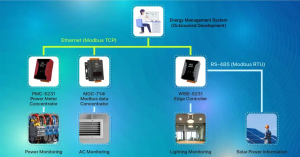
ICP DAS USA deployed an integrated Energy Management System (EMS) that combines power monitoring, lighting control, HVAC management, and solar energy data into a single platform. The solution delivers real-time visibility, centralized control, and data-driven energy optimization, helping reduce energy consumption and improve building efficiency.
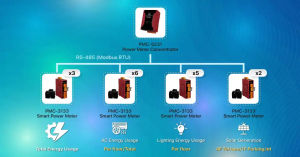
16 PM-3133 Smart Power Meters and a PMC-5231 Power Meter Concentrator were deployed in just two days to monitor building-wide energy consumption, HVAC and lighting usage, and solar power generation. The web-based system provides real-time and historical energy insights, helping facility managers identify savings opportunities and improve overall energy performance.
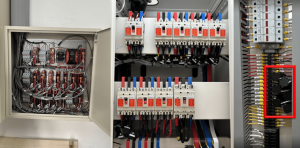
The site was already equipped with a power meter and split-core current transformers (CTs) to measure the building’s total electricity consumption. By directly adding a PM-3133 Smart Power Meter to the existing system, total power consumption data could be easily acquired. This significantly reduced installation complexity and costs, enabling aging buildings to be quickly upgraded into smart energy management facilities.
The facility’s existing two-way lighting control system lacked centralized management and scheduling capabilities, requiring staff to perform manual inspections and adjustments.
ICP DAS USA upgraded the system without replacing lighting fixtures or disrupting the building’s interior. By integrating the existing lighting infrastructure into a smart energy management platform, the facility gained centralized monitoring, automated scheduling, and more efficient lighting control.
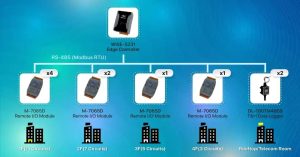
WISE-5231 Edge Controller and eight M-7065D Remote I/O Modules, ICP DAS USA connected lighting systems across four floors to a centralized EMS platform. Automated schedules and zone-based control ensure lights are used only when needed, reducing manual management, energy consumption, and operating costs.
The building’s 77 HVAC units could only be operated individually using remote controls or a local HMI, with no centralized management. This often resulted in air conditioners running in unoccupied areas, increasing energy costs and limiting visibility into system performance.
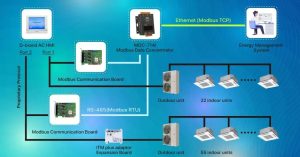
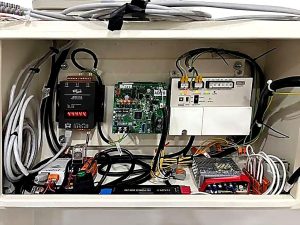
The facility’s HVAC system generated 770 Modbus data points across 77 indoor units, resulting in slow communication and control delays. By implementing the MDC-714i Modbus Data Concentrator, ICP DAS USA streamlined data management and reduced command response times from 10 to 20 seconds to 1 to 2 seconds.
This enhanced communication efficiency by nearly 10×, enabling faster, more reliable, and easier-to-manage HVAC operations.
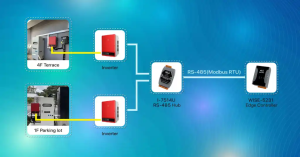
Solar panels powering the site’s EV charging stations were installed in the parking area and rooftop terrace. Without real-time monitoring, facility managers had limited insight into energy production and system performance.
Conclusion:
ICP DAS USA transformed an aging facility into a smart, low-carbon building by integrating power monitoring, lighting control, HVAC management, and solar energy data into a centralized Energy Management System (EMS).
The solution provides real-time visibility, automated control, and actionable insights that help reduce energy consumption, lower operating costs, and support sustainability goals.
By leveraging existing infrastructure and deploying the system with minimal disruption, the project created a scalable model for future smart building and energy-efficiency initiatives.