
Smart Hospital Infection Prevention with ICP DAS USA LoRa Wireless Modems and Mobile Robots
Introduction
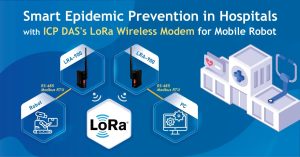
The COVID-19 pandemic transformed healthcare operations and increased the demands on hospital staff, especially in isolation wards where patients require continuous care. To help reduce staff workload and minimize the risk of cross-infection, a hospital partnered with technology providers to develop a mobile epidemic prevention robot.
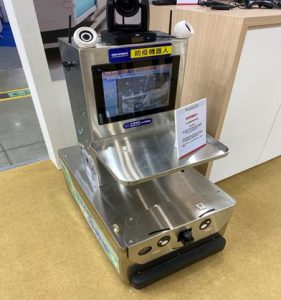
Equipped with a transport tray, the robot can deliver items such as medications, identification cards, and other essentials to isolation wards, reducing direct person-to-person contact. The robot also features a camera that allows medical staff to remotely monitor patients and capture images when needed. Through its built-in display and voice communication system, healthcare providers can conduct remote consultations, stay informed about patient conditions, and deliver care more safely and efficiently.
ICP DAS USA LoRa Wireless Modems Enable Remote Diagnosis and Patient Care
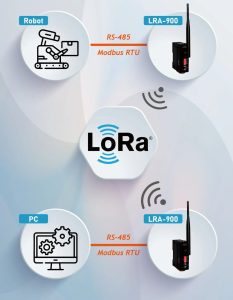
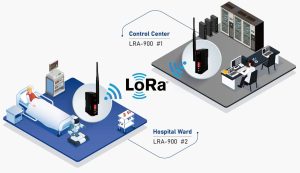
In this application, the mobile epidemic prevention robot is equipped with an ICP DAS USA LRA-900 LoRa Wireless Modem. Using long-range LoRa wireless communication, the robot connects to another LRA-900 modem at the control center, enabling reliable data transmission between the two locations.
The control center’s LRA-900 then transfers the collected information to a computer through the Modbus RTU communication protocol, allowing medical staff to remotely monitor patients and support diagnosis and treatment activities. The system architecture is shown below.
ICP DAS USA LRA-900 LoRa Wireless Modem Features
The ICP DAS USA LRA-900 is a Modbus RTU-to-LoRa wireless data converter that uses transparent transmission technology to send and receive data over long distances without altering the original information. This creates a reliable wireless communication link between devices, making it ideal for applications such as mobile healthcare robots and remote monitoring systems.
The LRA-900 supports wireless data rates up to 10,000 bps and can achieve communication distances of up to 1.5 km (0.93 miles) in line-of-sight environments. For installations exposed to electrical noise or interference, the transmission rate can be reduced to improve signal stability and anti-jamming performance.
To further enhance reliability, the LRA-900 offers configurable wireless channels and group IDs, allowing multiple networks to operate within the same area while minimizing interference between devices.
Key Benefits
ICP DAS USA Wireless Communication Solutions
Different wireless technologies serve different application requirements. ICP DAS USA offers a broad range of industrial wireless communication solutions that enable serial and Ethernet devices to communicate through LoRa, 3G/4G/5G, Wi-Fi, RF, and ZigBee networks.
These solutions simplify connectivity across large facilities and remote locations where running cables is difficult, expensive, or impractical. From industrial automation and environmental monitoring to smart infrastructure and remote asset management, ICP DAS USA wireless products provide reliable and scalable connectivity.
ZigBee Wireless Solutions
ZigBee is a low-power wireless communication technology designed for industrial automation, monitoring, and distributed control systems. It offers reliable communication over distances ranging from approximately 10 to 700 meters while providing excellent noise immunity, security, and cost efficiency.
ICP DAS USA offers a comprehensive portfolio of ZigBee products, including:
These solutions are widely used in:
For example, in smart aquaculture applications, ZigBee wireless modules can transmit sensor data from remote fishponds back to a central control system, helping operators improve productivity, reduce operational risk, and support sustainable practices.
Flexible ZigBee Product Options
ICP DAS USA provides ZigBee communication modules for a variety of network architectures, including:
These products enable seamless data collection and transmission across industrial networks, making it easier to connect field devices with supervisory and control systems.
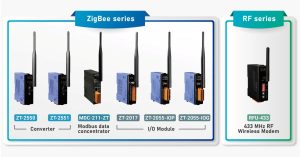
RF Wireless Communication Solutions
Radio Frequency (RF) technology enables wireless data transmission over radio waves and is widely used in industrial communication applications. To support reliable long-distance wireless connectivity, ICP DAS USA offers the RFU-433 Wireless Modem, which converts RS-232 and RS-485 communications to 433 MHz RF wireless transmission.
Operating at a communication speed of 9,600 bps, the RFU-433 can achieve transmission distances of up to 1 km (0.62 miles) under line-of-sight conditions. For environments with high levels of electrical noise or interference, the wireless baud rate can be adjusted down to 650 bps to improve anti-noise and anti-jamming performance.
The RFU-433 also includes 16 wireless channels and 8 group IDs, allowing users to create multiple independent networks while preventing interference between neighboring RF systems. This flexibility makes it a reliable solution for industrial monitoring and control applications.
The RFU-433 has also been successfully deployed in ICP DAS USA’s wireless monitoring solution for overhead cranes in bicycle painting production lines, where reliable communication is critical for maintaining operational visibility and efficiency.
Conclusion
Using the ICP DAS USA LRA-900 LoRa Wireless Modem, the mobile epidemic prevention robot can be monitored and controlled remotely while enabling real-time patient observation. By supporting remote diagnosis, communication, and monitoring, the solution reduces direct contact between healthcare staff and patients, helping lower the risk of infection while improving operational efficiency.
As organizations continue to adapt to evolving healthcare and industrial challenges, remote monitoring and intelligent IoT technologies play an increasingly important role. ICP DAS USA offers a wide range of wireless communication solutions, including LoRa, RF, ZigBee, Wi-Fi, and cellular technologies, helping customers implement reliable IIoT systems and meet the growing demand for connected, data-driven operations.


