
| Share On: | |
|---|---|
| Categories: | PCI Data Acquisition Boards | PCI Express Data Acquisition Boards | PCI Express Digital I/O | PCI Digital I/O |
| Review: | Write your review |
| Resources: |  User's ManualData Sheet User's ManualData Sheet UniDAQ UniDAQ PIN Assignment PIN Assignment
|
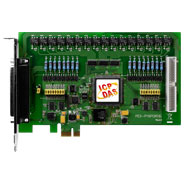
The PCI-P16POR16 is a PCI card supporting both the 5 V PCI bus, while the PEX-P8POR8i/PEX-P16POR16i is a PCI Express card. Each contain 8 or 16 optically isolated input channels and 8 or 16 PhotoMos relay output channels. Both the isolated DI channels and the PhotoMos relay channels use a short optical transmission path to transfer an electronic signal between elements of a circuit and keep them electrically isolated. The PCI-P16POR16 provides 5000 Vrms and PEX-P8POR8i/P16POR16i provide 2000 VDC for DI channel isolation protection, allowing the input signals to be completely floated so as to cut down ground loops, block voltage spikes, and isolate the host computer from damaging voltages. PhotoMos relays are used where it is necessary to control a circuit using a low-power signal (with complete electrical isolation between the control and controlled circuits), or where several circuits must be controlled by one signal. The PEX-P16POR16i is fully compatible with the PCI-P16POR16, and users can easily replace the PCI-P16POR16 with the PEX-P16POR16i without any need for software/driver modification when using PCI Express computers.
The PEX-P16POR16i/PEX-P8POR8i also adds a Card ID switch on-board. Users can set Card ID and then recognizes the board by the ID via software when using two or more PEX-P16POR16i/PEX-P8POR8i cards in one computer. The PCI-P16POR16 and PEX-P16POR16i/PEX-P8POR8i can be used in various applications, such as controlling the ON/OFF state of external devices, driving external relays or small power switches, activating alarms, contact closure, sensing external voltages or switches, etc.
These cards support various OS versions, such as Linux, DOS, Windows 98/NT/2000 and 32/64-bit Windows 7/Vista/XP. DLL and Active X control together with various language sample programs based on Turbo C++, Borland C++, Microsoft C++, Visual C++, Borland Delphi, Borland C++ Builder, Visual Basic, C#.NET, Visual Basic.NET and LabVIEW are provided in order to help users quickly and easily develop their own applications.
[PEX-P8POR8i/PEX-P16POR16i]
| Digital Input | |
| Isolation Voltage | 2000 VDC (Photo-couple) |
| Channels | 8 |
| Input Voltage | Logic 1:AC/DC 5 ~ 24 V(AC 50 ~ 1 kHz) Logic 0: AC/DC 0 ~ 1 V |
| Response Speed | Without Filter: 50 kHz (Typical) With Filter: 0.455 kHz(Typical) |
| Relay Output | |
| Channels | 8 |
| Relay Type | PhotoMos Relay(Form A) |
| Contact Rating | Load Voltage: 300 V (AC peak or DC) Load Current: 130 mA |
| Operate Time | 0.7 ms (typical) |
| Release Time | 0.05 ms (typical) |
| Insulation Resistance | 23 Ω |
| Special | |
| LED Indicators | Output status |
| General | |
| Bus Type | PCI-Express x1 |
| Data Bus | 16-bit |
| Card ID | Yes (4-bit) |
| I/O Connector | Female DB37 x 1 |
| Dimensions (L x W x D) | 183 mm x 105 mm x 22 mm |
| Power Consumption | 800 mA @ +5 V |
| Operating Temperature | 0 ~ 60 °C |
| Storage Temperature | -20 ~ 70 °C |
| Humidity | 5 ~ 85% RH, non-condensing |
Our mission is to provide the absolute best customer experience in industrial automation and electronics, without exception.


Subscribe to our mailing list today and join thousands of others who want to stay up-to-date with the latest news in data acquisition and industrial data communication.
ICP DAS USA is a leading manufacturer of industrial data acquisition, data communication, programmable controllers, wireless and software solutions.
Add a review
Your email address will not be published. Required fields are marked *