
| Share On: | |
|---|---|
| Categories: | I-8000 Specialty Modules |
| Review: | Write your review |
| Resources: |
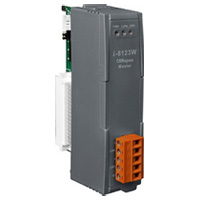
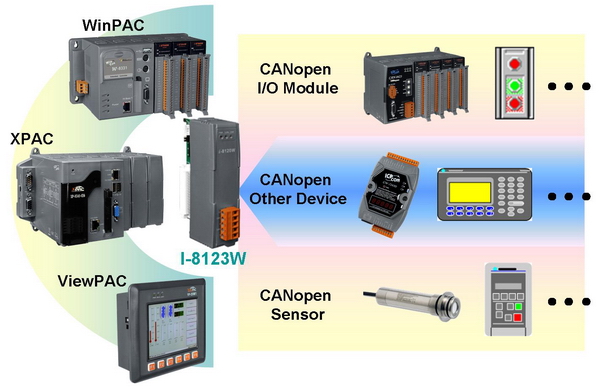
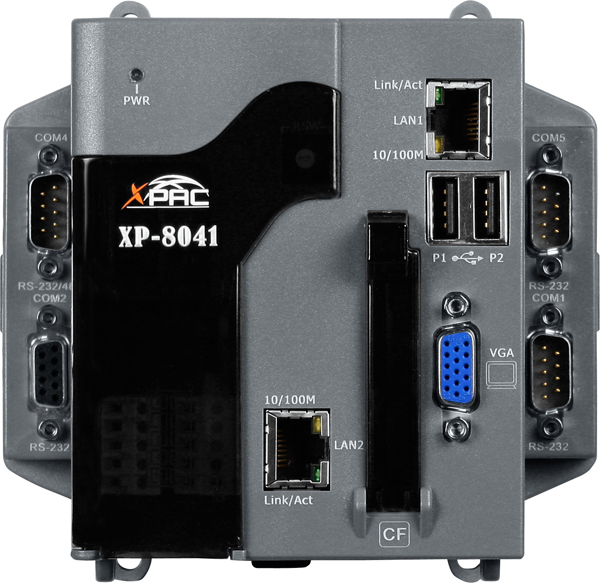
The CAN (Controller Area Network) is a serial communication protocol, and efficiently supports distributed real-time control with a very high level of security. It is an especially suit for networking "intelligent" devices as well as sensors and actuators within a system or sub-system. In CAN network, there is no addressing of subscribers or stations in the conventional sense, but instead prioritized messages are transmitted. As standalone CAN controller, I-8123W can represent an economic solution of CANopen application and be a CANopen master device in the CAN bus on the CANopen network. It follows CiA standard specific DS-301 v4.02 and several communication service functions to communicate with slave devices. It has an independent CAN bus communication port with 5-pin screw terminal connector, and has the ability to cover a wide range of CANopen applications. Besides, I-8123W uses the CAN controller Phillips SJA1000T and transceiver 82C250/251, which provide bus arbitration, error detection with auto correction and re-transmission function. It can be installed in WinPAC, ViewPAC, XPAC now. It is popularly applied in the industrial automation, building automation, vehicle, marine, embedded control network and etc. In order to expand the CANopen functions of ICPDAS products, I-8123W module is developed for this purpose.

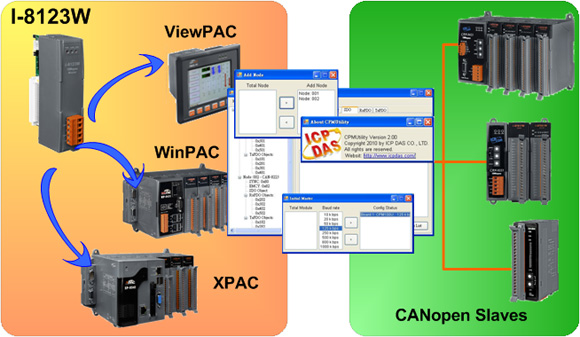
The CPMUtility utility can easily to access the I/O data of all the slave devices. The users can monitor the input data of the specific slave device and change the output data to the remote slave device with this utility.
CAN Interface |
|
Controller |
NXP SJA1000T with 16 MHz clock Microprocessor inside with 20MHz |
Transceiver |
NXP 82C250 |
Channel number |
1 |
Connector |
5-pin screwed terminal block (CAN_L, CAN_SHLD, CAN_H, N/A for others) |
Baud Rate (bps) |
10k, 20 k, 50 k, 125 k, 250 k, 500 k, 800 k, 1000 k |
Transmission Distance (m) |
Depend on baud rate (for example, max. 1000 m at 50 kbps ) |
Isolation |
3000 VDC for DC-to-DC, 2500 Vrms for photo-couple |
Terminator Resistor |
Switch for 120 Ω terminator resistor |
Specification |
ISO-11898-2, CAN 2.0A and CAN 2.0B |
Protocol |
CANopen DS-301 ver4.02 |
Hardware |
|
CPU |
80186, 80 MHz or compatible |
SRAM/Flash/EEPROM |
512 KB / 512 KB / 16 KB |
NVRAM |
31 bytes (battery backup, data valid for up to 10 years) |
RTC (Real Time Clock) |
Yes |
Watchdog |
CPU built-in |
LED |
|
Round LED |
PWR LED, Rx/Tx LED, ERR LED |
Software |
|
Driver |
Windows CE5, Windows CE6 |
Library |
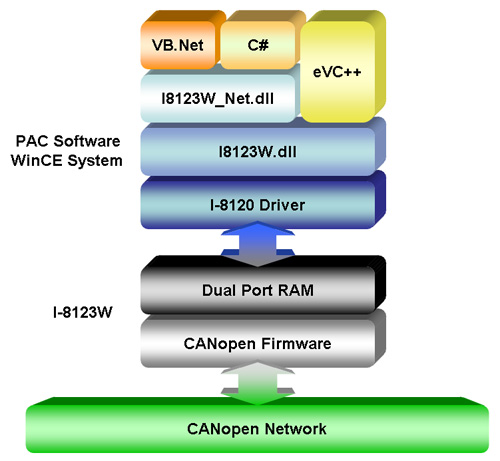
For CE5: VB.Net, C#.Net, VC 2005 (with .Net Framework 2.0 or upper), and eVC++ 4.0 For CE6: VB.Net, C#.Net, VC 2008 (with .Net Framework 3.5 or upper) |
Power |
|
Power Consumption |
2 W |
Mechanism |
|
Dimensions |
31mm x 115mm x 91mm (W x L x H) |
Environment |
|
Operating Temp. |
-25 ~ 75 ℃ |
Storage Temp. |
-40 ~ 80 ℃ |
Humidity |
5 ~ 95% RH, non-condensing |
Our mission is to provide the absolute best customer experience in industrial automation and electronics, without exception.


Subscribe to our mailing list today and join thousands of others who want to stay up-to-date with the latest news in data acquisition and industrial data communication.
ICP DAS USA is a leading manufacturer of industrial data acquisition, data communication, programmable controllers, wireless and software solutions.
 User's Manual
 PIN Assignment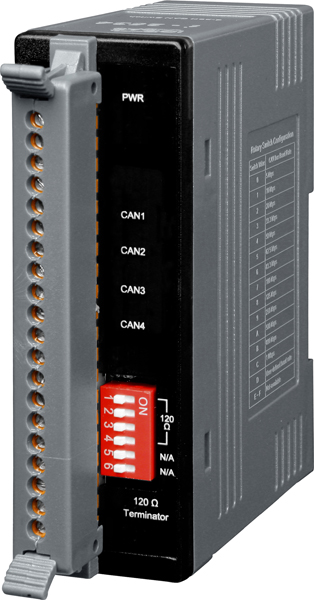
Add a review
Your email address will not be published. Required fields are marked *