
| Share On: | |
|---|---|
| Categories: | Modbus Converters and Gateways | Modbus Converters | HART Converters and Gateways Data Communication | HART Converters and Gateways |
| Review: | Write your review |
| Resources: |
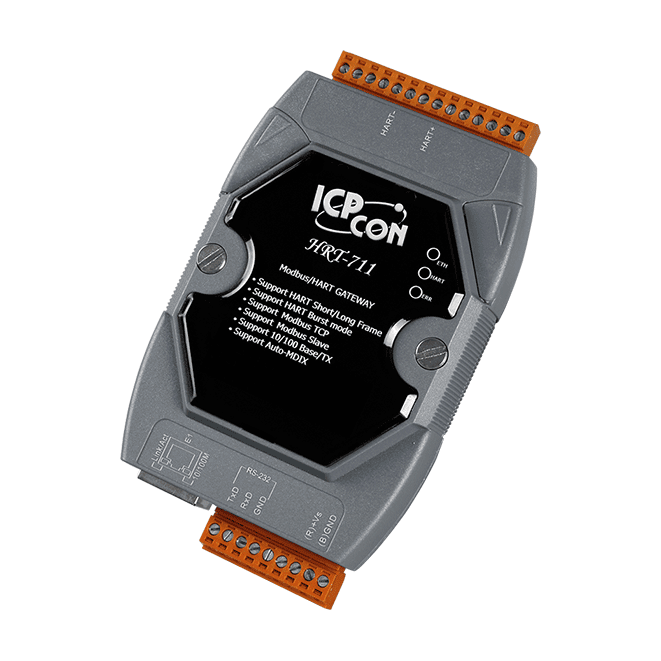
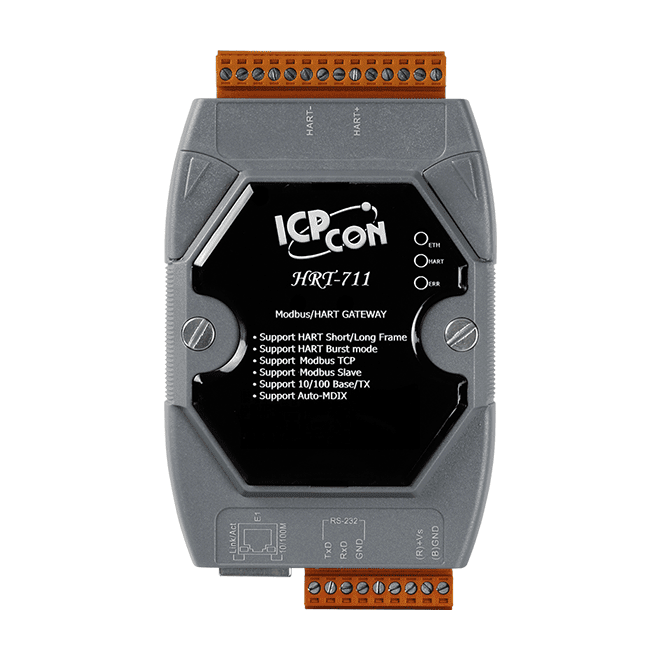
 The HRT-711 Modbus TCP to HART Gateway is specially designed for the master device of HART protocol. It allows the Modbus/TCP master device to access the HART slave devices. These HART devices may be a transmitter, an actuator, a current output device and so forth. In addition, we also provide the utility software for users to configure the HRT-711. By using this module, users can integrate their HART devices into Modbus network easily.
The HART (Highway Addressable Remote Transducer) protocol uses the Bell 202 Frequency Shift Keying (FSK) standard to superimpose digital communication signals on the 4-20 mA loop current shown as below figure. HART communicates at 1200 bps without interrupting and interference with the 4-20mA signal and allows a host application (master) to send/receive digital information from a smart field device. The 4-20mA signal communicates the primary measured value - the fastest and most reliable industry standard. The digital signal can be used for additional device information including device status, diagnostics, additional measured or calculated values, etc. Therefore, the HART communication including analog and digital information provides a low-cost and very robust complete field communication solution that is easy to use and configure. HART is a master/slave protocol which provides for up to two masters (primary and secondary) and the secondary master such as handheld can be used to monitor/control the informatoin of HART bus. HART can be used in various modes such as point-to-point or multi-drop for communicating information to/from smart field instruments and central control or monitoring systems. The following are the description of two main HART operation modes.
| Code | name | Description |
| 01 | Read Coil Status | Read the ON/OFF status of discrete outputs in the slave |
| 02 | Read Input Status | Read the ON/OFF status of discrete inputs in the slave |
| 03 | Read Holding Registers | Read the binary contents of holding registers in the slave |
| 04 | Read Input Registers | Read the binary contents of input registers in the slave |
| 05 | Force Single Coil | Write a single output in either ON or OFF in the slave |
| 06 | Preset Single Register | Write an integer value into a single register in teh slave |
| 15 | Force Multi. Coils | Write each coil in teh sequence of coils to either ON or OFF in the slave |
| 16 | Preset Multi. Registers | Write a block of contiguous registers in the slave |
| Ethernet | |
|---|---|
| Ports | 10/100Base-TX Ethernet Controller (Auto-negotiating, Auto_MDIX) |
| COM Ports | |
|---|---|
| Ports | RS-232(3 wires) |
| HART | |
|---|---|
| Ports | 1 |
| Device | 2-wired or 4-wired HART devices |
| Topology | Point to Point or Multi-Drop |
| Data | Only Digital Data |
| Frame Type | Short and Long Frame |
| Burst Mode | Supported |
| Max. HART Device | 15 |
| Loop Resistor | 250 resistor by Jumper |
| Isolation | UL1577 Spec. |
| Protocol | 2-pin screwed terminal block |
| Power | |
|---|---|
| Reverse Polarity Protection | Power reverse polarity protection, Over-voltage brown-out protection |
| Input Range | Unregulated +10 ~ +30 VDC |
| Consumption | 1 W |
| Mechanical | |
|---|---|
| Dimensions (mm) | 72 x 35 x 121 (W x L x H) Detail |
| Installation | DIN-Rail or Wall Mounting |
| Environment | |
|---|---|
| Operating Temperature | -25 ~ +75 °C |
| Storage Temperature | -30 ~ +80 °C |
| Humidity | 10% ~ 90% RH, Non-condensing |
Our mission is to provide the absolute best customer experience in industrial automation and electronics, without exception.


Subscribe to our mailing list today and join thousands of others who want to stay up-to-date with the latest news in data acquisition and industrial data communication.
ICP DAS USA is a leading manufacturer of industrial data acquisition, data communication, programmable controllers, wireless and software solutions.
 CE Certification
 Software
 2D DWG Drawing
Add a review
Your email address will not be published. Required fields are marked *