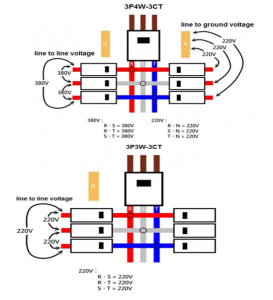
In a three-phase wye connected electrical system, voltage can be measured in two primary ways.
Line-to-line voltage is the voltage measured between any two phase conductors such as phase A to phase B, phase B to phase C, or phase A to phase C.
Line-to-ground voltage, also referred to as line-to-neutral voltage, is the voltage measured between each phase conductor and neutral, including phase A to neutral, phase B to neutral, and phase C to neutral.
The relationship between these voltages in a balanced wye system is:
VLN = VLL / √3 ≈ VLL / 1.73
Example:
In a 380 V three-phase wye system, the line-to-line voltage is 380 V. The line-to-ground voltage is approximately 220 V (380 ÷ 1.73).
The ICP DAS PM-3133 Series power meters support accurate measurement of both voltage types, making them suitable for power monitoring, energy management, electrical diagnostics, data centers, manufacturing facilities, and utility monitoring applications.