
An air separation system is designed to extract nitrogen and oxygen from atmospheric air for use in various industrial processes. Today, most small and medium-sized air separation units (producing less than 10,000 m³/h) rely on a “PLC + SCADA” control architecture. This combination provides stable performance, simplified operation, and high-level automation—making it ideal for industries seeking energy-efficient gas production.
Among modern approaches, Vacuum Pressure Swing Adsorption (VPSA) technology has become a preferred method for air separation. VPSA systems utilize pressure-based adsorption and desorption cycles to separate gases efficiently, providing either high-purity oxygen or nitrogen depending on the adsorbent materials used. Compared to traditional cryogenic air separation systems, VPSA systems offer faster startup, lower capital investment, shorter construction time, and reduced energy consumption—making them especially attractive for industries such as steel production, wastewater treatment, and chemical processing.
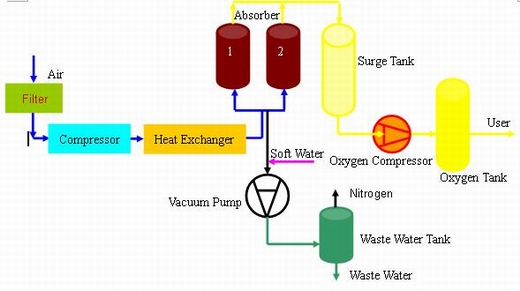
In a typical VPSA oxygen production setup, the main components include fans, vacuum pumps, adsorbers, heat exchangers, and oxygen compressors, supported by auxiliary systems such as water circulation and air instrumentation networks.
-Air Filtration & Compression: Ambient air passes through a high-efficiency air filter to remove particulates before being compressed by the blower.
-Cooling & Adsorption: The compressed air is cooled via a heat exchanger and enters the adsorber unit. Specialized adsorbents selectively remove water vapor, CO₂, hydrocarbons, and nitrogen.
-Desorption & Regeneration: Once the adsorbent becomes saturated, the system switches to a vacuum phase to release trapped gases, regenerating the adsorbent for the next cycle.
Each adsorption column operates in five key steps—adsorption, directional depressurization, vacuum desorption, pressure equalization, and pressurization—controlled automatically by pneumatic valves under PLC command. This fully automated cycle ensures reliable, continuous production of oxygen or nitrogen.
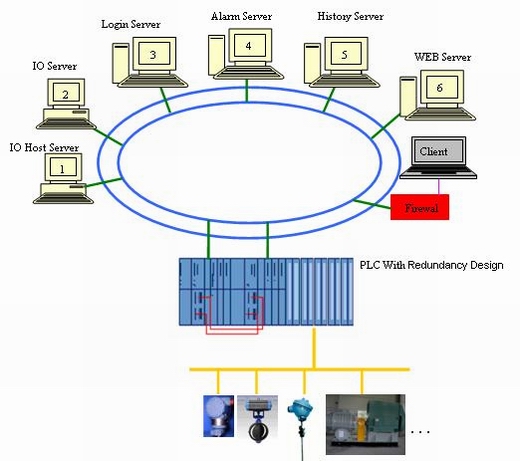
The air separation control system integrates a dual-CPU redundant PLC with a modern SCADA supervisory system, meeting industrial reliability standards and enabling fully unmanned operation.
The SCADA platform provides:
-Real-time process visualization
-Automated alarm and event handling
-Secure remote access and control
-Data logging, trending, and historical analysis
-Web-based reporting and remote diagnostics
Network redundancy is achieved through a fiber-optic ring topology, ensuring continuous data flow and high system uptime. The SCADA network typically includes the following servers:
-I/O Server: Handles real-time data acquisition from field devices.
-Alarm Server: Manages real-time and historical alarms with visual and audible alerts.
-Historical Data Server: Stores and retrieves time-stamped process data.
-Web Server: Publishes live dashboards and reports through secure network access.
-Login & Authentication Server: Ensures only authorized users can modify configurations or access system data.
-Even if the SCADA interface experiences downtime, PLC logic continues to manage critical interlocks and PID controls to maintain safe operation.
The SCADA system continuously collects and displays operational data from fans, air compressors, vacuum pumps, and oxygen compressors. Engineers can view live process diagrams, numerical values, and status indicators. Graphical trends and real-time curves help operators optimize cycle timing and energy usage.
SCADA automatically issues visual and audible alarms whenever process parameters exceed predefined limits. Operators are immediately notified to take corrective action. Authorized users can adjust alarm thresholds or process parameters directly through the SCADA interface.
Most VPSA system valves operate automatically under SCADA supervision. The software coordinates valve sequencing for molecular-sieve desorption and manages PID loops for critical parameters. The system also provides manual override capabilities for maintenance or troubleshooting.
All process data is archived for future reference. Users can review historical trends, analyze performance over time, and export data for compliance or maintenance reporting. Historical data storage supports long-term traceability for oxygen production efficiency.
SCADA includes detailed user authentication, ensuring that only qualified engineers or administrators can modify configurations. This enhances cybersecurity and process integrity, especially in remote or unattended installations.
Customizable reports—such as shift logs, daily summaries, and monthly performance reports—can be generated automatically and printed or shared via secure web portals.
The dual-CPU PLC configuration provides millisecond-level failover in case of hardware failure, ensuring uninterrupted control of the air separation process. Similarly, redundant SCADA servers provide automatic backup and recovery for real-time data and alarms.
Firewall protection and controlled IP access prevent unauthorized external connections, safeguarding both operational data and system stability. This design meets modern industrial cybersecurity best practices.
Field deployments of the “PLC + SCADA” control model in small and mid-scale VPSA oxygen systems have demonstrated excellent reliability and operator satisfaction. Users report:
-Improved plant uptime due to hardware and network redundancy
-Reduced operator workload through automated monitoring and reporting
-Optimized oxygen yield and lower energy consumption through PID tuning and historical analysis
-Simplified maintenance with remote access and diagnostic tools
The architecture’s openness and scalability allow easy integration with Modbus TCP, EtherNet/IP, and OPC protocols, enabling data sharing with plant-wide SCADA, MES, or cloud monitoring platforms.
Integrating SCADA systems with PLC-based control provides a robust, flexible, and efficient solution for modern VPSA air separation plants. This architecture delivers the stability and real-time visibility that industries need to maintain high-purity oxygen or nitrogen production at minimal operational cost.
With the continued advancement of SCADA and PLC technologies, this combined approach will remain a cornerstone of industrial automation—helping air separation plants achieve greater reliability, faster deployment, and improved energy performance in demanding industrial environments across North America and worldwide.


