
Modern power plants rely on advanced automation systems to ensure efficiency, safety, and reliability across all operational units. SCADA (Supervisory Control and Data Acquisition) and industrial database solutions play a vital role in managing auxiliary systems such as chemical water treatment, coal handling, ash handling, and steam instrumentation systems (SIS). These systems require real-time monitoring, precise control, and seamless data exchange to maintain stable power generation and reduce operational costs.
In the past, each auxiliary workshop within a power plant operated as an isolated automation system. Each had its own PLC-based control system, local operator station, and independent control room, with no communication between stations. This structure created “automation islands,” limiting data visibility and efficiency. Compared to the main plant control system, these auxiliary systems required more personnel and manual intervention, resulting in higher labor costs and lower productivity. With the widespread adoption of Distributed Control Systems (DCS) and SCADA platforms, utilities began integrating these isolated subsystems into unified plant networks. Optimizing and modernizing the control systems of auxiliary units has become a crucial step in achieving full automation, reducing manpower, and improving process coordination.
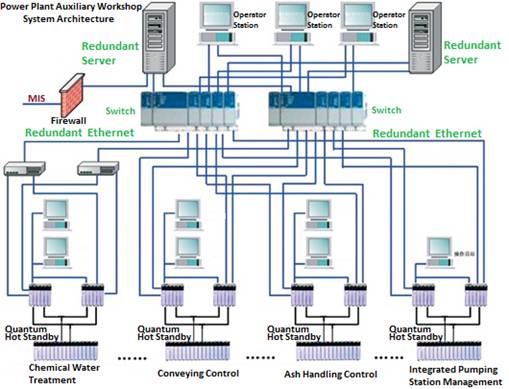
By standardizing on the same type of PLC and industrial PC hardware, and utilizing modern Ethernet-based communication, plant operators can form a comprehensive control network for the entire Balance of Plant (BOP) system. The network diagram of this integrated auxiliary control system is shown below.
The control network adopts a redundant star topology Ethernet architecture, designed to ensure continuous operation even if a single communication path fails. Two master switches serve as the core network backbone, while each PLC or subsystem acts as an independent node. Connections between devices are made using shielded CAT5e twisted-pair cables (STP) and 50/62.5 μm multimode fiber, forming two fully mirrored star networks for maximum reliability and high-speed communication.
Stable Redundancy: Dual-redundant host controllers ensure continuous system operation, even in the event of hardware or communication faults.
Optimal Network Architecture: The star topology provides high communication reliability, simplified troubleshooting, and scalable system expansion.
Centralized Management: All sub-stations and auxiliary processes can be remotely monitored and controlled from a central management station via the SCADA network.
Seamless Integration: Open communication protocols such as Modbus TCP/IP and OPC allow easy integration between SCADA, PLCs, and higher-level plant systems like SIS or DCS.
Real-Time Data and Alarming: Operators can monitor performance parameters, equipment status, and alarms in real time from centralized or remote terminals.
After implementing a fully automated and unmanned auxiliary workshop, network reliability becomes essential. While redundant hardware provides fault tolerance, software-level redundancy and distributed data management further enhance system robustness. The Auxiliary Workshop Centralized Monitoring System is built on the principle of data distribution and risk dispersion. The main software applications in the BOP control network include SCADA visualization, data historian, and industrial database management.
The SCADA solution uses a three-tier client/server architecture for distributed control and monitoring:
On-Site PLC Control System: Acts as the foundational layer, providing real-time operational data to the SCADA system and receiving commands from operator stations. PLCs manage critical field devices such as pumps, valves, fans, conveyors, and sensors.
SCADA and OPC Server Layer: Serves as the intermediary layer, collecting data from field PLCs, executing server-side logic, and generating graphical HMI displays. The SCADA server processes operator commands, updates data points, and archives all operational information into the central database for historical analysis and reporting.
Operator Station (Client): Displays live process data, trend charts, and alarm summaries from the SCADA server. Operator stations provide intuitive access to the system database for querying reports, reviewing historical data, and managing alarms. These clients connect through the BOP control network and can communicate directly with the SIS (Supervisory Information System) for plant-wide data sharing.
This architecture allows real-time visibility across all auxiliary systems and integrates seamlessly with the plant’s main control system. Operators gain centralized control over distributed processes while maintaining redundancy and fault tolerance at every level.
The SCADA-based Power Plant Auxiliary System provides a stable, efficient, and fully automated solution for managing critical plant support operations. Through integrated hardware redundancy, software-based reliability mechanisms, and a robust Ethernet communication network, the system delivers uninterrupted operation and high availability. Centralized SCADA monitoring enhances coordination across multiple workshops, reduces maintenance downtime, and supports unmanned operation with automatic fault detection and alarm management. By consolidating control into a unified BOP network, power plants can achieve improved reliability and safety of auxiliary systems, reduced operational and maintenance costs, enhanced data transparency and traceability, optimized manpower utilization, and streamlined integration with SIS and DCS networks. With its distributed architecture and open communication design, this SCADA solution empowers modern power plants to achieve high efficiency, remote manageability, and long-term operational sustainability across all auxiliary systems.


