
Smart Water Monitoring for Reliable Water Purification Operations
Introduction
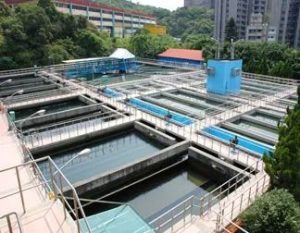
Located in Keelung, northeastern Taiwan, the Shin-Shan Water Purification Plant is one of the region’s largest water treatment facilities. Because it supplies drinking water for residential use, it must meet strict water quality and production requirements, including maintaining raw water turbidity levels and supporting a treatment capacity of up to 150,000 cubic meters per day (CMD).
To help ensure reliable water quality, improve operational efficiency, and enable real-time oversight, the facility implemented a smart water monitoring solution that provides continuous monitoring and centralized management of critical treatment processes.
Smart Water Monitoring Solution
Water Quality Monitoring
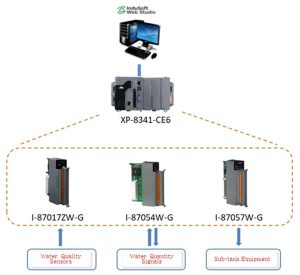
Water quality sensors continuously measure critical parameters such as turbidity, pH, hardness, nitrite nitrogen, fluoride, color, odor, and bacterial levels. Sensor data is transmitted as standard 4-20 mA signals through the I-87017ZW-G analog input module to the XP-8341-CE6 PAC, where the data is analyzed and processed. If abnormal conditions are detected, the system immediately notifies operators, enabling rapid response and helping maintain water quality standards.
Water Flow and Valve Monitoring
The I-87054W-G digital I/O module monitors valve status and water flow operations, sending real-time information to the XP-8341-CE6 PAC. Any valve malfunction or flow-related issue is automatically reported to the supervisory system, allowing operators to address problems quickly and minimize operational disruptions.
Sedimentation Tank Control
During water treatment, coagulants are added to aggregate suspended particles into larger solids through a process known as flocculation. The water then flows into sedimentation tanks, where these solids can settle and be removed.
To optimize tank utilization, ICP DAS USA I-87057W-G digital output modules automatically control sedimentation tank operations. When a tank reaches capacity, the system redirects water flow to the next available tank, helping ensure continuous and efficient treatment processes.
Key Benefits of the Solution
Centralized Remote Monitoring
Using the InduSoft SCADA platform, operators can access real-time data through an intuitive, visual interface. This enables centralized monitoring, faster decision-making, and improved operational efficiency across the facility.
Simplified System Integration and Expansion
The XP-8341-CE6 PAC communicates with the SCADA system using standard Modbus RTU/TCP protocols, making it easy to integrate additional devices and expand the system as requirements grow.
Reliable Performance in Harsh Environments
Designed for industrial applications, ICP DAS USA solutions provide stable, dependable operation in challenging conditions, including high temperatures and high-humidity environments common in water treatment facilities.
Enhanced System Protection
The I/O modules feature built-in isolation protection to help prevent damage from electrical surges, noise, and electrostatic discharge, ensuring reliable data acquisition and system operation.
Conclusion
The ICP DAS USA Smart Water Monitoring Solution helped the Shin-Shan Water Purification Plant improve operational visibility, increase efficiency, and reduce the need for manual inspections. By providing real-time monitoring, automated control, and centralized data management, the system enables operators to respond more quickly to issues and maintain reliable water treatment performance.
ICP DAS USA’s expertise in automation, control, and data acquisition was demonstrated through the successful deployment of a stable and scalable solution capable of operating in demanding environments. In addition to Modbus-based systems, ICP DAS USA also offers edge computing and communication solutions that support protocols such as Modbus TCP and MQTT, along with wired and wireless connectivity options including ZigBee, Wi-Fi, 3G, and 4G. This flexibility allows ICP DAS USA to deliver tailored solutions that meet a wide range of industrial monitoring and control requirements.


