
Business Strategies for Managing Rising Water Costs
As climate change and supply costs continue to drive up water prices, governments around the world are introducing new water-use charges. As a result, businesses are increasingly looking for ways to improve water management and reduce operating costs.
One such business is a leading panel manufacturer that produces TFT-LCD displays, LCD modules, and touch panel modules. As a high-volume water user, the company previously relied on manual collection of data from water meters and flow meters located throughout its facility. This process was labor-intensive, time-consuming, and prone to transcription errors. It also lacked real-time visibility into water usage.
To improve efficiency, the company sought an automated meter reading solution that could provide accurate, real-time monitoring without requiring modifications to existing equipment.
This case study highlights how the customer implemented ICP DAS USA’s Real-Time Water Management Solution Across the Facility. This solution enables centralized real-time water usage by dividing the facility into three areas and customized a solution based on each area.
ICP DAS USA’s solution:
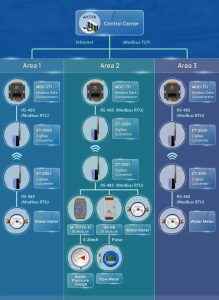
Areas 1 and 3 use water meters that record cumulative water consumption and support Modbus communication. Because these meters already provide digital data, no additional I/O modules were needed. Data is transmitted wirelessly through ZigBee using the ZT-2550 and ZT-2551 RS-485/RS-232 converters, then sent to MDC-711 Modbus Data Concentrators via the Modbus RTU protocol.
Area 2 includes large-diameter water pipelines equipped with water meters, pressure gauges, and ultrasonic flow meters. Water pressure data is collected by the M-7017Z-G Analog Input Module, while pulse signals from the ultrasonic flow meters are captured by the tM-P8 Digital Input Module with built-in counting functionality. The collected data is transmitted wirelessly via the ZT-2550 and ZT-2551 ZigBee converters and then forwarded to the MDC-711 Modbus Data Concentrators using the Modbus RTU protocol.
Finally, data from all three areas is sent to the AVEVA Edge SCADA system in the central control room via Modbus TCP, providing operators with a unified, real-time view of water consumption, flow rates, and pressure across the facility.
The system architecture diagram is shown below.
Conclusion:
As water costs continue to rise and ESG expectations grow, effective water management has become a strategic business priority. In addition to demonstrating energy performance through ISO 50001:2018 certification, companies are increasingly adopting the ISO 46001 Water Efficiency Management System standard to improve water efficiency, support sustainability goals, and enhance operational resilience.


