
| Share On: | |
|---|---|
| Categories: | PCI Data Acquisition Boards | PCI Multi-function | PCI Digital I/O |
| Review: | Write your review |
| Resources: |  User's ManualQuick StartData SheetPIN Assignment User's ManualQuick StartData SheetPIN Assignment Software Software UniDAQ Development Kit UniDAQ Development Kit
|
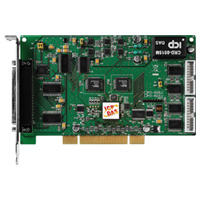
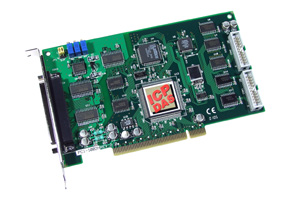
 The PCI-822LU is a high performance multifunction card providing high-speed analog I/O and digital I/O functions. The PCI-822LU card has a universal PCI interface supporting both 3.3 V and 5 V PCI bus. This card features a continuous, 250 k Samples/Sec 12-bit resolution A/D converter, 8 K samples hardware FIFO, 2-ch 16-bit D/A converter, 32-ch programmable digital I/O and DO read back. The PCI-822LU provides either 32-ch single-ended or 16-ch differential analog inputs which are jumper selectable. The PCI-822LU is equipped with a high speed PGA featuring programmable gain controls (1,2,4,8).
The PCI-822LU has the Card ID switch and pull-high/pull-low resisters for DI on board. Users can set Card ID on a board and recognize the board by the ID via software when using two or more PCI-822LU cards in one computer. The pull-high/pull-low resisters allow specifying the DI status; when the DI channels are unconnected, the DI status will remain in high or low status other than floating.
The PCI-822LU provides two programmable trigger methods: software trigger and pacer trigger. The A/D channel scan function of PCI-822LU is so amazing, we call it MagicScan. The MagicScan controller takes out most works of getting A/D value such as select channel, set gain, settling time, trigger ADC and get data. With the built-in MagicScan and interrupt features, it is effectively off-loading your CPU from the job. Even in channel scan mode, it can have different gain code for each channel, and the sampling rate can still reach 250 kS/s totally. The PCI-822LU is suitable for high end applications.
| Model Name | D/A Channel | A/D Channel | A/D Sampling Rate | FIFO Size | Software Trigger (Polling) | Pacer Scan (Magicscan) | Post-trigger Pre-trigger Middle-trigger |
Interrupt function | |
| PCI-822LU | 16-bit, 2-ch | 12-bit, 32 S.E/16 Diff | 250 kS./s | 8 k | V | V | V | V | Cost-effective Programmable DIO |
| Analog Input | |
| Channels | 32 single-ended/16 differential |
| AD Conversion | 12-bit, 4μs conversion time |
| Sampling Rate | 250 kS/s. max. |
| FIFO Size | 8192 samples |
| Over voltage Protection | Continuous +/-35 Vp-p |
| Input Impedance | 10,000 MΩ/4pF |
| Trigger Modes | Software, Pacer |
| Data Transfer | Polling, Interrupt |
| Accuracy | 0.1 % of FSR ±1 LSB @ 25 °C, ± 10 V |
| Zero Drift | 15 ppm/°C of FSR |
| Analog Output | |
| Channels | 2 |
| Resolution | 16-bit |
| Accuracy | ± 6 LSB |
| Output Range | -5 V ~ 5 V , -10 V ~ 10 V, 0 ~ 10 V, 0 ~ 5 V |
| Output Driving | +/- 5 mA |
| Slew Rate | 8.33 V/μs |
| Output Impedance | 0.1 Ω max. |
| Operating Mode | Software |
| Programmable I/O | |
| Channels | 32 |
| Digital Input | |
| Compatibility | 5 V/TTL |
| Input Voltage | Logic 0: 0.8 V max. Logic 1: 2.0 V min. |
| Pull High/Pull Low | Yes |
| Response Speed | 1.0 MHz (Typical) |
| Digital Output | |
| Compatibility | 5 V/TTL |
| Output Voltage | Logic 0: 0.4 V (max.) Logic 1: 2.4 V (min.) |
| Output Capability | Sink: 40 mA Source: 20 mA |
| DO Read Back | Yes |
| Response Speed | 1.0 MHz (Typical) |
| General | |
| Bus Type | 3.3 V/5 V Universal PCI, 32-bit |
| Data Bus | 16-bit |
| Card ID | Yes(4-bit) |
| I/O Connector | Female DB37 x 1 20-pin box header x 2 |
| Dimensions (L x W x D) | 169 mm x 105 mm x 22 mm |
| Power Consumption | 1 A @ +5 V max. |
| Operating Temperature | 0 ~ 60 °C |
| Storage Temperature | -20 ~ 70 °C |
| Humidity | 5 ~ 85% RH, non-condensing |
| Analog Input Range | ||||
| Gain | 1 | 2 | 4 | 8 |
| Bipolar | +/- 10 | +/- 5 | +/- 2.5 | +/- 1.25 |
| Sampling Rate Max. | 250 kS/s. | 250 kS/s. | 250 kS/s. | 250 kS/s. |
Our mission is to provide the absolute best customer experience in industrial automation and electronics, without exception.


Subscribe to our mailing list today and join thousands of others who want to stay up-to-date with the latest news in data acquisition and industrial data communication.
ICP DAS USA is a leading manufacturer of industrial data acquisition, data communication, programmable controllers, wireless and software solutions.
Add a review
Your email address will not be published. Required fields are marked *